


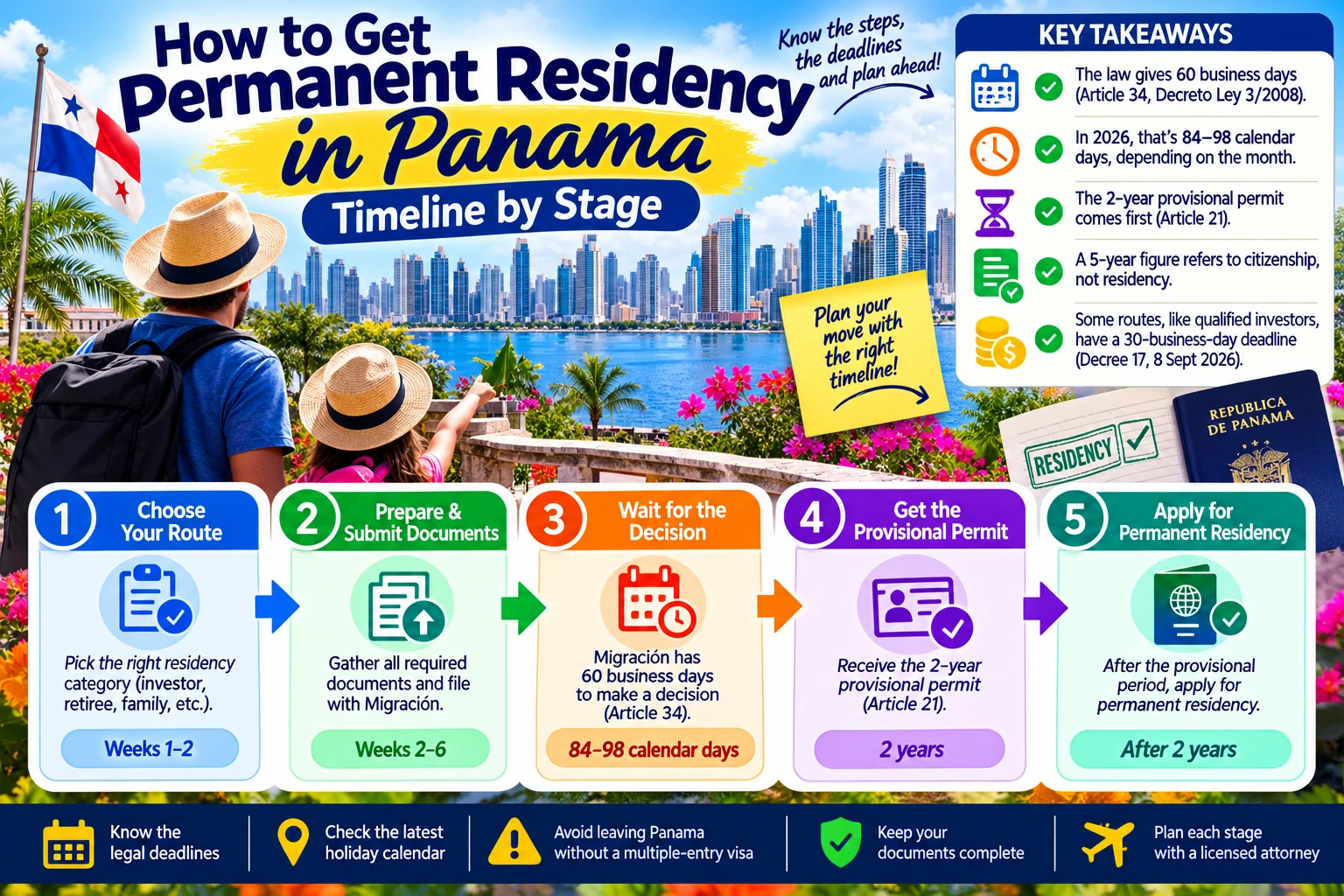
How to Get Permanent Residency in Panama: Timeline by Stage
You’ve picked a route. You’re paying a lawyer to file it. What you need now isn’t another comparison of visa types. It’s a calendar. Retirees still choosing a route can start with the Pensionado visa requirements.
When do you give notice on the lease? How soon can the shipping container sail? Will this take one trip to Panama, or three? When is the card in your hand?
The pages that rank for this question give you one number. Two to three years, or five, depending on which heading you read. None of them mention the deadline in the law itself. That deadline is counted in business days. So the month you file can shift your date by two weeks.
Key takeaways
- Article 34 of Decreto Ley 3 de 2008 gives the Servicio Nacional de Migración a maximum of “sesenta días hábiles” (60 business days) to decide a residence application.
- Against Panama’s declared 2026 holidays, those 60 business days run 84 to 98 calendar days. An October filing costs about two weeks more than a July one.
- The two-year wait isn’t a law firm’s guess. Article 21 grants a two-year provisional permit first. You apply to stay permanently after it ends.
- The five-year figure in competitor headings belongs to citizenship, not to residency. They are separate clocks.
- One route now has a tighter deadline in law. Decreto Ejecutivo 17 of 8 September 2026 sets 30 business days for a qualified investor decision.
- Leaving Panama mid-process without a multiple entry and exit visa is the costliest scheduling mistake here. Two firms put the fine near US$2,000.
- Migración publishes no real processing times. A legal maximum is not a forecast, and nothing here is a promise about your file.
The deadline the law sets
Panamanian law gives Migración 60 business days to decide. That comes from Article 34 of Decreto Ley 3 de 22 de febrero de 2008. It was published in Gaceta Oficial Digital No. 25986 on 26 February 2008. Article 34 says such cases are resolved “en un término no mayor de sesenta días hábiles.” If your filing is incomplete, that same article gives you 15 business days from notice to fix it.
No page competing for this query quotes that number. It matters twice over.
First, it gives you a yardstick. A firm tells you to expect six months. You can now see that’s roughly double the legal cap, and you can ask why.
Second, it tells you what sort of number you hold. A legal cap is not an average. It’s the outer limit the law puts on the government. Migración publishes no data on how often it hits that limit.
One limit on the limit: Article 34 covers residence permits, both temporary and permanent. It isn’t a general deadline for every immigration request, so don’t carry the 60 days across to a visa application.
One footnote, because it gets misread. Article 34 has a parágrafo transitorio. If no decision came within the term, “la solicitud se entenderá aprobada a favor del solicitante.” Silence would mean approval. But that paragraph applied only in the first year after the law took effect, back in 2008. Don’t plan around it.
The foundational structure of Decreto Ley 3 de 2008 remains intact regarding these specific deadlines. The 60-business-day cap (“sesenta días hábiles”) mandated for the National Immigration Service (SNM) to resolve residency applications under Article 34 has not been amended away, nor has the 15-business-day window to cure defective filings. (The transitional “positive silence” clause you noted indeed expired in 2009). The article’s reference to Article 21 (the mandatory 2-year provisional period before permanent residency for most categories) is also correct and remains current law.
What 60 business days means on a real calendar
Between 84 and 98 calendar days. Which end you get depends on the month you file.
Business days skip weekends and public holidays. Panama’s holidays cluster. Three days of Carnaval in February. Two at Easter. Five in early November, four of them patriotic dates.
Panama’s declared 2026 non-working days are listed in resolution SBP-ADM-R-2026-00003, dated 5 January 2026, from the Superintendencia de Bancos. It names Decreto Ejecutivo No. 38 de 5 de diciembre de 2025 as the source of that year’s holiday declarations. Apply that calendar to Article 34:
| You file | 60 business days expire | Calendar days |
|---|---|---|
| 15 January 2026 | 16 April 2026 | 91 |
| 2 February 2026 | 5 May 2026 | 92 |
| 15 April 2026 | 9 July 2026 | 85 |
| 15 July 2026 | 7 October 2026 | 84 |
| 1 September 2026 | 1 December 2026 | 91 |
| 15 October 2026 | 21 January 2027 | 98 |
The legal maximum under Article 34, counted against Panama’s declared 2026 holidays. Worked out for this article. Check it against the holiday decree for the year you file.
Panama Holiday Penalty Calculator
How filing dates delay 60 business days in 2026
A July filing gets the shortest run at 84 days. The term lands in a stretch with no holidays in it. File in mid-October and the same 60 business days take 98 calendar days. That term swallows the November dates and the end-of-year closures.
So a fortnight of difference comes from nothing but the date on the receipt. If your lawyer has any flexibility about when to file, that’s where it’s worth spending.
The stages, and what each one hands you
Five stages, and each one hands you a different document. Filing gets you a receipt. Next comes a provisional permit, which carries two years of status and an ID. Then the resolution, the written decision itself. After that you apply to stay for good, and last of all comes the card.
Your lease, your container, and your flights attach to those stages, not to a total. The dedicated timeline pages give a total and stop.
| Stage | What it produces | Where its deadline comes from |
|---|---|---|
| Filing | A receipt while the case is pending | Article 34 |
| Provisional permit | Two-year provisional residence, plus an ID document | Article 21 |
| Resolution | The written decision granting or refusing residence | Article 34, 60 business days |
| Permanent application | Filed once the two-year provisional period ends | Article 21 |
| Permanent resident card | The carné de residente permanente | Articles 139 and 140 |
Two of those stages deserve pulling out. They’re where the competing pages go wrong.
The Permanent Residency Journey Map
Which stages require you to be physically in Panama?
Submit original files, register passport, complete biometric scans.
Obtain your 2-year provisional residence card and provisional ID.
Filed after 24 months. You must return to verify your final file status.
Receive “Resolución” decision & register biometric details for Cédula ID.
Where the two years comes from
Article 21. That’s worth knowing, because it changes how much weight the figure carries. Migración grants anyone in the permanent residence categories “un permiso provisional de residencia de dos años.” An ID document comes with it. Once those two years end, the holder may ask to stay for good.
So the two-year wait isn’t one firm’s house guess that a rival might undercut. It sits in the law. The same two-year step turns up in the 2026 decrees too. That’s a fair sign it’s the default, not a quirk of one route.
The card comes from a different agency.
Articles 139 and 140 send you to the Tribunal Electoral, not to Migración. Article 139 requires permanent residents to get a new personal ID document, the one “que para tales efectos apruebe el Tribunal Electoral.” Article 140 says that phrase means the “carné de residente permanente.”
The ndm.com.pa timeline page never mentions this stage, though the card is the thing you actually end up holding. Legalys, a Panamanian firm, wrote on 1 July 2026 that a carnet for a case in process “se obtiene en 5 días.” It says the Cédula E is arranged once approval lands.
Under current Tribunal Electoral rules, obtaining the Cédula E (the permanent resident ID card) is a mandatory in-person process. The applicant must appear physically at a Tribunal Electoral office for biometrics (photo and signature). The standard processing fee is B/.50.00 for a first-time issuance, and delivery typically takes 5 to 8 business days, aligning closely with the 5-day estimate you quoted from Legalys.
The five-year figure is a different clock.
Five years, in Panamanian residency talk, nearly always means citizenship. It rarely means residency. Keeping those apart is the most useful thing on this page, because one competitor merges them inside a single article.
The timeline page at ndm.com.pa carries two headings that promise five years to permanent residency. One is for the Friendly Nations visa, the other for Self Economic Solvency. The body text under those same headings says something else:
“Initially, you’ll receive a 2-year temporary resident visa, and after these two years, you can apply for permanent resident status.”
Its conclusion says, “The process usually takes about 2-3 years.” That page also carries a heading reading “Express Entry: Panama’s 2-Year Route to Permanent Residency” with no text beneath it at all.
Elsewhere, ndm.com.pa does attach five years to something real: “After 5 years of legal permanent residence and full immigrant status, one can apply for citizenship in Panama.”
Read it together, and the pattern is clear. The page’s body and its conclusion describe two years to permanent residency. Its only explained five-year period is the one before citizenship. Those headings attach that second clock to the first question. Article 21’s two-year provisional permit is what the law sets for reaching permanent residency.
Decreto Ejecutivo 17 de 2026 also ties citizenship to five consecutive years of residence, for the route it governs. That fits the citizenship clock, not the residency one.
The deadlines that bind you
Here’s the part that moves your dates. Article 34’s 60 business days bind the government. You can’t speed that up. The deadlines that bind you are much shorter. Missing one costs you more than Migración being slow.
- 15 business days to fix a defective filing. Article 34. Counted from notice, not from when you hear about it. Notified on 10 February 2026, that window shuts on 6 March. Notified on 28 October, it shuts on 25 November.
- 30 calendar days to report a change. Article 37 says you must tell the Registro de Extranjería about any change to the information you gave it, “en un plazo no mayor de treinta días calendario.” Article 87 puts the same duty on a change of address once you hold status.
- Five business days to challenge a decision. Article 96 allows reconsideration before the Director General, plus an appeal to the Minister. Both are filed within five business days of notice.
- About ten business days in the country to file. This one isn’t a legal deadline. It’s practical. Kraemer & Kraemer advise clients “to plan for at least a 10-business-day stay to complete a Friendly Nations Visa application.”
The pattern is worth noticing. Every deadline on the government runs to dozens of days. Every deadline on you runs to days or a few weeks. Each one starts from a notice you might not be in the country to receive.
Leaving Panama while your case is open
This is the trap, and it sits in the law. Article 48 says the multiple entry and exit visa goes, on request, to a foreigner “que se encuentre tramitando el cambio de su estatus migratorio.” That’s exactly where you stand between the provisional permit and the permanent grant.
Then Article 49 says what the visa does. The holder may come and go “un número ilimitado de veces, mientras se mantenga vigente.”
The cost of getting this wrong needs care, because the sources don’t line up neatly.
Two Panamanian firms give a figure. Kraemer & Kraemer describe someone who leaves “without having obtained a Multiple Entry Visa during his Panama residency process.” That person could face “fines of USD 2,000 or more.”
Panama Legal Group puts the fine at “dos mil dòlares (US$2,000.00).” That firm’s post went up in January 2015 and was last changed in May 2023. It calls the visa one “requerida por Migración a TODO extranjero que haya iniciado un trámite migratorio.” It also says the visa usually arrives “entre 1 a 3 dìas hàbiles.” Panama’s balboa runs at parity with the dollar, so those two figures name the same amount.
A published fine schedule carries a matching figure. But it attaches that figure to a differently worded breach. A table on the site of Panamanian attorney Kery Cruz lists a first-offence fine of “Multa de B/. 2,000.00” for breaching a multiple-entry visa where the authorised term has expired. It cites Articles 49 and 90 of the Decreto Ley, together with Decreto Ejecutivo 320. Article 49’s own penalty wording also points at staying past the authorised term, rather than at leaving without the visa.
So the figure is real, and it does appear in a published schedule. But the breach that schedule describes isn’t word for word the one the firms warn about. The Kery Cruz page carries no date beyond a 2010 copyright line. That page itself tells readers to check its figures against Migración. Treat US$2,000 as the right order of magnitude, and treat the warning as sound. Get your own exposure from your attorney before you book anything.
The standard fine cited by immigration firms (US$2,000) for leaving the country while a residency application is “en trámite” without a valid Multiple Entry and Exit Visa (Visa Múltiple) is effectively accurate in practice. When an applicant leaves without this visa, their pending residency application is legally considered abandoned. To recover the process, Migración generally levies a fine of B/.2,000 to rehabilitate the file (often cited under the broader penalties for violating authorized stay conditions or abandoning a process).
What goes wrong, and what the delay costs
Three things go wrong often enough to plan for. The resolution comes back with an error in it. The file gets shelved for lack of follow-up. Or a public holiday lands inside your term. The first two have published figures attached.
Those figures sit on a different page from the timeline, which makes them easy to miss. The page is Kraemer & Kraemer’s piece on challenges in the Panama residency process, written by Johana Sum, the firm’s General Manager. It was first published on 1 November 2019 and last modified on 21 October 2025. It gives stage-level numbers no timeline page carries:
- Resolutions “are typically corrected within 1-3 months depending on Migration.”
- “We estimate that 6-8% of clients have an error in their resolution.”
- “It usually takes Migration 3-4 days to retrieve a document from the archive.” That applies where a file was shelved for lack of follow-up.
- Clients are told to “return within one to two months” after approval to collect the card. They should book “one to two weeks before your arrival” so the office can pull the file.
Set that against Article 34 and the risk changes shape. A correction that takes one to three months can run as long as the original decision term. On the firm’s own estimate, it hits roughly one client in twelve to one in sixteen. That’s low. It isn’t rare enough to leave out of a plan.
Those are one firm’s numbers, from its own caseload, and the firm sells the service. They aren’t official statistics. Migración publishes nothing to compare them against. They are the most specific figures available, which is not the same as the most reliable.
Residency Deadlines Compared
Notice the stark difference in your deadline windows
Residency permit decisions must be resolved (Art. 34)
Special fast-track investment decisions (Executive Decree 17)
To cure and correct filing defects (from official notice date)
Report any updates of domicile/assets (Decreto Ley 37)
To challenge any adverse decisions (Art. 96)
What changed in 2026
Three executive decrees from 2026 touch this ground. No page competing on this query has taken them in. One of them is the first tighter decision deadline in the system.
Decreto Ejecutivo 17 de 8 de septiembre de 2026 was published in Gaceta Oficial Digital No. 30613 on 16 September 2026. It replaces Decreto Ejecutivo 722 de 2020 and governs permanent residence as a qualified investor. Its Article 15 sets two deadlines. The investment certification “contará con un plazo máximo de quince (15) días hábiles.” The migration application “deberá ser resuelta en un plazo no mayor de treinta (30) días hábiles.” Article 21 says the decree takes effect on promulgation.
Thirty business days from a 15 January 2026 filing would expire on 3 March. From 15 October, on 3 December. That’s half the general term in Article 34, written for one route.
Decreto Ejecutivo 16 de 31 de agosto de 2026 adds Ecuador to the Friendly Nations list. Fábrega Molino reported it on 8 September 2026 and named Gaceta Oficial No. 30601-B. The firm describes three qualifying routes: a qualifying job, a Panamanian property investment of at least US$200,000, or a fixed-term bank deposit of at least US$200,000 held for three years or more.
Mondaq wrote about the same decree on 8 October 2026. It said the decree lets Ecuadorian nationals apply for the Permanent Resident subcategory. Fábrega Molino refers only to “residencia.” It doesn’t say whether the grant is permanent or provisional first.
Those two accounts don’t settle on the same answer. Article 21’s provisional step is the legal default. So an Ecuadorian reader should get this checked before planning around it.
Decreto Ejecutivo No. 3 del 6 de febrero de 2026 created a permanent residence subcategory for long-term foreign students. EY named that decree in an alert dated 11 February 2026. It describes eligibility as “más de seis años consecutivos de estudios a tiempo completo.” It describes a route to permanent residence “tras dos (2) años de permiso provisional.”
Fragomen covered the same subcategory on 9 February 2026. It says the route covers “students who have completed more than six consecutive years of study in Panama.” The usual permanent residence rules apply, “(except for the repatriation deposit),” and a two-year provisional permit comes first.
For a minor, Fragomen says the filing comes from both parents. It can also come from one parent with the other’s authorisation, or from whoever has legal custody. Fragomen gave no decree number.
A fourth 2026 decree turned out to be irrelevant here. It’s worth saying so, to save the next reader the search. Decreto Ejecutivo 15 de 14 de agosto de 2026, in Gaceta Oficial No. 30590, extends a transit visa requirement for Cuban nationals. It has nothing to do with residency.
Keeping it once you have it
Come back inside within two years. That’s the practical rule, and the mechanism behind it is worth knowing, because it isn’t automatic.
Article 31 says the Director General “podrá cancelar la permanencia o residencia.” Its third numeral gives a ground that applies to permanent residents. That ground is being away from the country “por más de dos años.” It does not apply if the absence is justified and the Director approves it. The cancellation provisions in Decreto Ley 3 don’t use the word suspension at all.
So the real mechanism is cancellation. It’s a choice, not a rule. It sits with the Director General, and there’s a way to justify the absence.
That isn’t quite what the ndm.com.pa page describes. Its wording runs:
Residents “must visit the country at least every 2 years,” and “should stay in the country for more than 24 hours.” Otherwise residency “may be suspended.” But “this suspension is not automatic,” and “the immigration officer has the authority to suspend a permanent residency at his discretion.”
The gap matters for one reason. A ground for cancellation can be answered with a justification. A visit rule with a fixed penalty cannot. The 24-hour element also doesn’t turn up in any article read for this page.
You correctly spotted a discrepancy. Article 31 of Decreto Ley 3 de 2008 stipulates that permanent residency can be cancelled if the resident remains outside of Panama for more than two consecutive years unless properly justified. There is no statutory 24-hour minimum stay requirement written into Panamanian immigration law to reset this clock.
As long as the resident’s passport is stamped entering the country before the two-year mark expires, the clock resets. The “24 hours” mentioned by ndm.com.pa is likely a conservative firm policy rather than a legal statute. Furthermore, you are correct that this cancellation is executed at the discretion of the Director General of SNM, not an automatic suspension triggered by a border agent.
How many trips does this take?
At least one, and realistically two. Your attorney’s answer governs, because it turns on the route and on what they can file under a power of attorney.
The first trip is the filing. Kraemer & Kraemer suggest planning for at least ten business days in Panama for a Friendly Nations filing. With weekends, that’s roughly two calendar weeks in country.
Your second trip collects the card. The same firm advises returning within one to two months of approval. It says to book one to two weeks ahead, so the office can pull your file.
The gap between those two trips is what catches people. Say you’re in Panama with a case pending and you leave without the Article 48 visa. The exposure described above applies. That visa is what turns this from two fixed trips into a schedule you can move.
I filed for the Friendly Nations visa on March 12, received the provisional permit on August 4—145 calendar days later—and successfully collected our Cédula E in mid-September after a two-week processing delay at the Tribunal Electoral.
Frequently asked questions
Is there an official processing time for Panamanian permanent residency? There’s an official maximum, which is a different thing. Article 34 sets 60 business days for the decision. Decreto Ejecutivo 17 de 2026 sets 30 for the qualified investor route. What doesn’t exist is any published record of real waits. Migración’s home page and its own FAQ page give no processing times at all.
Why do firms quote longer than the legal maximum? Because they describe what they see, not what the law requires. Legalys, in its 2026 guide, puts final approval at up to six months. That’s about twice the 60-business-day term measured on a 2026 calendar. Neither figure is a promise. The gap between them is a fair thing to raise with your attorney.
Can I start the process from outside Panama? Partly. Your attorney decides how much. Gathering documents, legalising them, and translating them all happen wherever you are. Filing generally needs you in the country, and so does collecting the card. Your paperwork travels. You still have to show up.
Does the two-year provisional period count toward citizenship? Ask your attorney, and the distinction on this page is why. The citizenship clock in circulation runs from five years of permanent residence. That starts after the provisional period, not during it. Get the start date confirmed rather than assumed.
What happens if my resolution has a mistake in it? It gets corrected, and the correction has its own clock. Kraemer & Kraemer estimate that 6 to 8 percent of their clients have an error in the resolution. They say corrections typically take one to three months.
Where the record runs out
Everything above is as firm as the sources allow. The sources have a shape worth naming.
Every elapsed-time figure in circulation here comes from a law firm that sells the service. That isn’t an accusation. Firms hold the caseload data, and they report it honestly as estimates. But a firm’s typical case is not a general expectation, and none of these figures carries an independent audit.
Migración publishes no processing times. The record of its own decrees is also partial. The 2026 index lists decrees 3, 5, 6, 7, 8, 12, 15, 16 and 17. Eight numbers are missing from that run.
There’s a second sign of the same thing. File names for decrees 5, 6 and 7 carry May dates, while their titles read March and April. Newest on the index is a resolution dated 10 September 2026. Treat that index as a partial record.
Three gaps remain on this page. The full texts of Decreto Ejecutivo 3 of February 2026 and Decreto Ejecutivo 16 of August 2026 could not be extracted during research. What’s described for those two comes from EY, Fragomen, and Fábrega Molino, not from the decrees. The Tribunal Electoral’s own card pages would not load, so the carné stage rests on a law firm’s account plus the statute. And Decreto Ley 3 has been amended since 2008, so the article wording quoted here needs checking against a current edition.
What this page can give you is the structure. Which stages exist. What each one produces. Which deadline governs it. And which of those deadlines you control. Your dates come from your attorney.
The Real Panama Residency Timeline
Forget the law firm guesstimates. Here is the actual statutory calendar, the trips you must take, and the expensive traps to avoid.
60 Business Days ≠ 2 Months
Article 34 caps decision times at 60 business days. But Panama’s holiday calendar turns that into 84 to 98 calendar days. When you file changes your wait time by up to two weeks.
The 5-Stage Journey Map
1. Application Filing
Register passport & biometric scans.
✈️ Trip 1 Required (In Panama)2. Provisional Permit (Art. 21)
Grants 2-year temporary status & ID.
Completed during Trip 13. The Resolution
The written decision (max 60 business days).
Handled Remotely by Attorney4. Permanent Application
Filed after 24 months of provisional status.
✈️ Trip 2 Required5. Cédula E (Permanent Card)
Tribunal Electoral issues your permanent ID.
Collected on Trip 2Article 21 sets a mandatory 2-year temporary period before you can apply to stay permanently.
This clock does NOT start when you file. It starts only after you achieve permanent status.
Strict Deadlines That Bind You
The $2,000 Leaving Trap
If you leave Panama while your application is pending without first securing a Multiple Entry & Exit Visa (Art. 48), your process is considered abandoned. Rehabilitating the file carries a fine of around $2,000.
Before you set any dates
- Ask your attorney which filing date they’re targeting. Count 60 business days forward on a Panamanian holiday calendar. That’s your earliest reasonable expectation, not your plan.
- Ask which stages need you physically in Panama, and for how long.
- Ask whether a multiple-entry and exit visa is going in alongside your case, and what it costs.
- Keep a reachable address on file with the Registro de Extranjería. The 15-business-day fix window and the five-business-day appeal window both run from notice.
- Don’t end a lease or book a container against any number on this page, including the legal ones.
Disclaimer: Read this page as background information only. It is not legal advice and cannot substitute for professional counsel. Your actual timing depends on the specific route filed, the completeness of your paperwork, and discretionary choices made by the Servicio Nacional de Migración case by case. Before booking non-refundable travel, ending leases, or committing to dates you cannot change, have your schedule confirmed by a licensed Panamanian immigration attorney. If you hold dual or multiple citizenship, verify exit and re-entry rules for each jurisdiction with qualified legal counsel.

Abakwa Studio is the publishing team behind Lifestyle Panama, with a background in advertising technology. Our guides are drafted with AI assistance and then reviewed by our editor, Muhammad Shoaib, who has experience working as a visa agent in Pakistan. For visa, residency and tax topics, we check our guides against official Panamanian government sources. They are general information, not legal or tax advice.

