


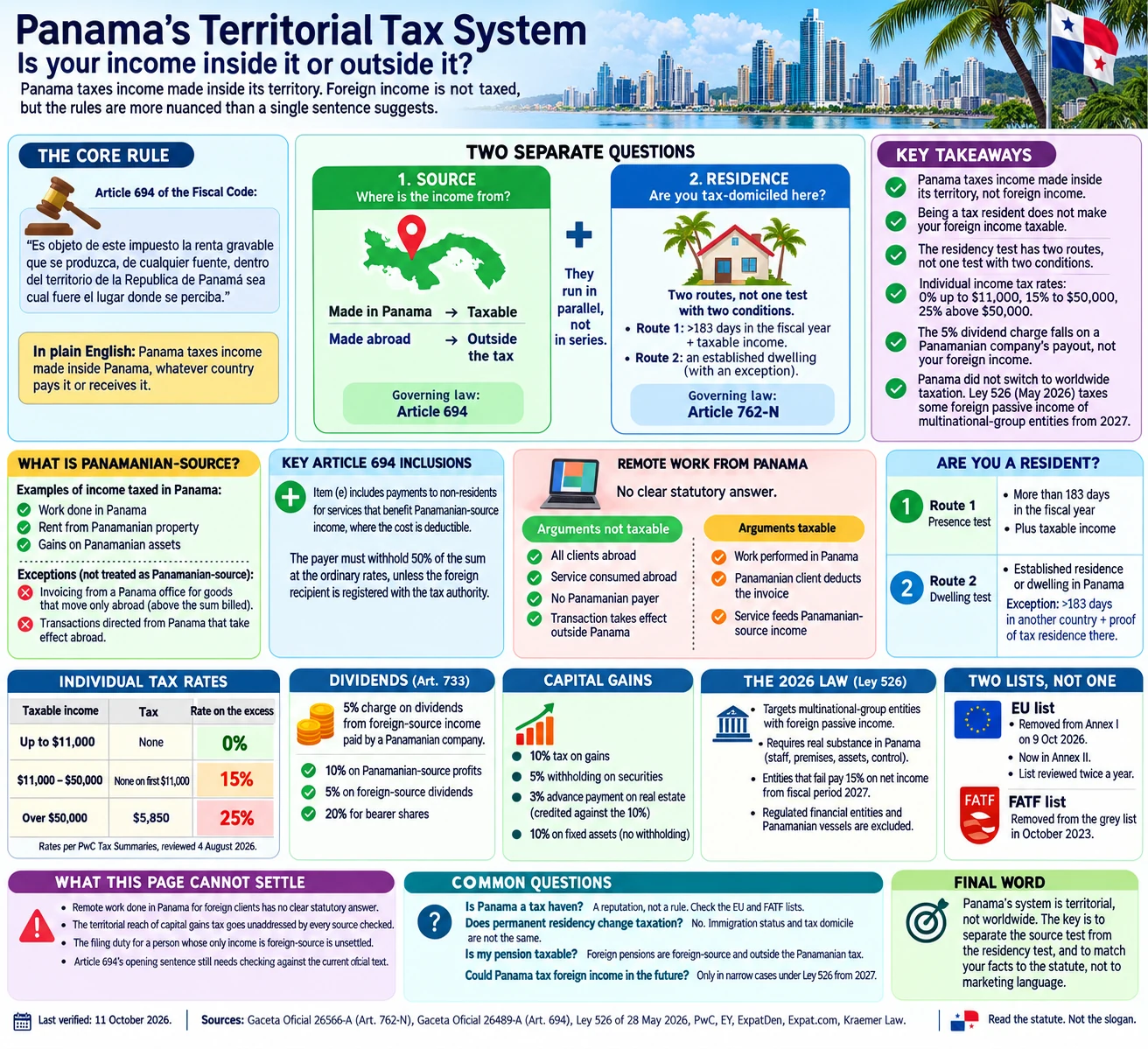
Panama’s territorial tax system: is your income inside it or outside it?
You moved, or you’re about to, partly on the strength of one sentence. Panama does not tax foreign income.
That sentence is broadly right. It’s also doing a lot of work that the pages repeating it seldom unpack.
Two worries usually sit underneath this search. The first is that “territorial” is a marketing word rather than a rule, and that a bill will arrive. The second is quieter. You may be failing to file something nobody told you about.
Here’s the short version. Panama taxes income made inside Panama. The rule is statutory, not promotional, and you can read it in Article 694 of the Fiscal Code.
But nearly every page ranking for this question merges two separate tests into one. That merge is where readers get hurt. Whether your income is taxable depends on its source. Whether you’re a Panamanian tax resident is a second question, governed by its own statute. Answering it does not switch your foreign income on.
Key takeaways
- Panama taxes income made inside its territory, whatever country pays it or receives it.
- Being a Panamanian tax resident does not make your foreign income taxable. The two questions are separate, and the residency rule sits in the Fiscal Code’s treaty chapter. Tax residence is also separate from immigration status, which follows its own permanent residency timeline.
- The residency test has two routes, not one test with two conditions. Three much-read sources each describe it differently, and each is partly wrong.
- Income tax on individuals runs 0% up to $11,000, then 15%, then 25% above $50,000.
- The dividend charge people cite as a contradiction falls on a Panamanian company’s payout. It is not a tax on your foreign income.
- Panama did not switch to worldwide taxation. A narrower law from May 2026 taxes some foreign passive income of multinational-group entities from fiscal period 2027.
- The EU took Panama off its non-cooperative list on 9 October 2026 and moved it to the cooperative annex. That’s a separate list from the FATF one.
- Remote work done in Panama for a foreign client is the one common case the law leaves unclear. A firm answer from anyone is a warning sign.
What Panama actually taxes
Panama taxes income made inside Panama, and the rule names no other basis. Article 694 of the Fiscal Code sets out what the tax reaches. In Spanish:
“Es objeto de este impuesto la renta gravable que se produzca, de cualquier fuente, dentro del territorio de la República de Panamá sea cual fuere el lugar donde se perciba.”
In plain English: the tax applies to taxable income made, from any source, inside Panamanian territory, whatever the place where it is received.
That last clause carries more weight than most summaries give it. “Wherever it is received” means the payment route decides nothing. Income made in Panama does not move outside Panamanian tax because it lands in a foreign bank account. Invoicing from abroad does not change where the work happened.
The mirror image is the part you came for. Income made outside Panama falls outside the scope of the tax. Not exempted by concession. Not sheltered by a structure. Outside the thing the statute describes.
The foundational opening sentence of Article 694 (“Es objeto de este impuesto la renta gravable que se produzca…”) remains fully intact and active. The 2010 reform (Ley 8 of 2010) appended and modified the subsequent paragraphs outlining specific inclusions/exclusions, but the core territorial definition in that opening sentence was not overwritten and still governs.
Two questions, not one
Source decides whether Panama taxes the income at all. Residence decides your treaty access and your filing posture. Neither one answers the other’s question.
- Question one, source. Was this income made in Panama? This sets whether Panama taxes it at all. Article 694 governs.
- Question two: residence. Are you domiciled in Panama for tax purposes? This sets treaty access, certificates, and filing posture. Article 762-N governs.
The giveaway is where the residency rule lives. Article 762-N entered the Fiscal Code through the reform in Gaceta Oficial 26566-A, dated 30 June 2010. It sits inside Chapter IX, headed “Normas de Adecuación a los Tratados o Convenios para Evitar la Doble Tributación Internacional.”
That is the chapter adapting the Code to double-tax treaties. The definition exists so treaty relief can be run. Its own third paragraph deals with proving residence to claim treaty benefits.
So becoming a Panamanian tax resident is not a switch that turns your pension into taxable income. In a worldwide system, residence pulls in global income. In a territorial one, it can’t, because the tax was never defined by reference to the person.
Panama’s Tax Tests: Source vs. Residence
Is your income Panamanian-source?
Work done in Panama, rent from Panamanian property, and gains on Panamanian assets are Panamanian-source. Income made abroad is not.
The statute then adds set inclusions and exclusions. For anyone with a cross-border set-up, those matter more than the broad rule.
Article 694’s second paragraph lists income that is not treated as made in Panama. Two items catch real situations:
- Invoicing from a Panama office the sale of goods that move only abroad, above the sum billed to that office.
- Directing, from an office in Panama, transactions completed, consummated or taking effect abroad.
That second item is the closest the statute comes to a rule for someone running a foreign-facing business from a desk in Panama City.
The first paragraph works the other way. It lists income that is Panamanian-source. Item (e), in the text printed in Gaceta Oficial 26489-A of 15 March 2010, reads:
“La recibida por personas naturales o jurídicas cuyo domicilio esté fuera de la República de Panamá producto de cualquier servicio o acto, documentado o no, que beneficie a personas naturales o jurídicas, nacionales o extranjeras, en la medida en que dichos servicios incidan sobre la producción de renta de fuente panameña o la conservación de esta y su erogación haya sido considerada como gastos deducibles por la persona que los recibió.”
In plain terms: someone based outside Panama gets paid for a service. That service feeds the making or keeping of Panamanian-source income. The Panamanian payer deducts the cost. On those facts, the payment is Panamanian-source. The payer then withholds on half the sum sent abroad, at the ordinary rates, unless the foreign recipient is registered with the tax authority.
Note the direction of travel. Item (e) is about money leaving Panama to a non-resident. It does not describe a Panamanian resident earning from abroad, which is the situation this page is about.
Remote work from Panama for a foreign client
This is the most-searched version of the question, and the law does not clearly answer it. Anybody giving you a firm yes or no is going past the sources.
The case for “not taxable” is real. On those facts, the service is used abroad, and the client is abroad too. Article 694’s second paragraph excludes transactions directed from Panama that take effect abroad. ExpatDen’s Panama tax guide treats a developer in Panama City paid by a US company as foreign-source and untaxed.
The case on the other side comes from the same statute. Remember that the tax reaches income “made” in Panama “wherever it is received,” and the work is done by a person sitting in Panama. ExpatDen itself calls remote services a grey area. It says the test is where the benefit is received. It also warns that income can be re-labelled as Panamanian-source if the benefit flows to a Panamanian entity. Kraemer Law’s page on personal income tax for expats doesn’t address remote work for a foreign employer. The Expat.com Panama tax guide never says where such income is treated as arising.
What follows is a view rather than an answer. The exclusion most likely to fit you is the one about transactions taking effect abroad, and it wasn’t drafted with salaried remote work in mind. If your clients are all abroad, and nothing you do feeds a Panamanian business, your case looks like foreign-source income. If any part of your work serves a Panamanian company that deducts the cost, the statute has language pointing the other way.
Remote Work: Fact Patterns
- All clients are located abroad
- The service is consumed entirely abroad
- No Panamanian payer is deducting the cost
- The transaction takes effect outside Panama
- Work is performed while physically sitting in Panama
- A Panamanian client is deducting your invoice as an expense
- The service feeds directly into Panamanian-source income
[HYPOTHETICAL: the case below is built to show how the two readings apply. It describes no real person and no ruling.] Take a designer living in Panama City. She invoices three clients in Canada, and she also does occasional work for a Panamanian restaurant that deducts her invoices. The Canadian work sits in the exclusion. The restaurant work has a Panamanian payer taking a deduction, which is the fact pattern the inclusion language is built around. Those two income streams may not get the same answer, and the second is the one to raise with an accountant.
When I established my own operations in Panama, my business consisted entirely of managing programmatic advertising yield, header bidding wrappers, and configuring AWS and Google Cloud infrastructure for clients based in the US and Europe. I needed absolute clarity on my filing duties. I retained a Panamanian tax attorney, and their written assessment was definitive: because my consulting and DevOps services were provided to foreign entities, consumed entirely abroad, and did not feed into the generation of any Panamanian-source income, my revenue was entirely foreign-source under Article 694. No Panamanian income tax applies, though filing a nil return annually remains good practice to maintain a clean local compliance record.
Are you a Panamanian tax resident?
Article 762-N gives two routes to tax domicile. Either one is enough. Here is where the much-read guides diverge from each other and from the statute.
Route one is the presence test. It treats you as domiciled on two facts together: you stay in national territory more than 183 days, consecutive or not, in the fiscal year, and you receive or accrue income subject to the tax.
Route two, the home test, treats you as domiciled if you’ve established your residence or dwelling in Panama. It carries an exception. You fall outside route two only by doing both of two things. Spend more than 183 days of the calendar year in a second country. Then prove you gained tax residence there. The proof goes to the Dirección General de Ingresos as a certificate from that country’s authorities.
Three sources state this test three ways, and the differences change the answer for real people.
| Source | How it describes the test | Where it departs from the statute |
|---|---|---|
| Article 762-N, Fiscal Code | Two separate routes: 183 days plus taxable income, or an established dwelling subject to an exception | The governing text |
| ExpatDen | A two-part test where both 183 days and a centre of vital interests must be met | Turns a separate route into a second condition. On that reading, someone with a Panamanian home and fewer than 183 days is not a resident. The statute suggests they may be |
| Expat.com | Either 183 days, or permanent residency plus Panama as centre of economic interests | Right that the routes are alternatives. Route two in the statute turns on a dwelling, not on immigration status or economic interests |
| PwC Tax Summaries | Physically located and generating income in Panama for more than 183 days | Faithful to route one, including the income condition the others drop. Route two is missing |
Two drafting points are worth taking to an adviser. Route one counts the “año fiscal” and route two counts the “año calendario,” and Article 762-N defines neither term. Taxable income is also required on route one, so presence alone is not the whole test there.
What residency does and does not change
Tax domicile in Panama gets you three things. Access to Panama’s double-tax treaties, a tax residency certificate, and a clearer filing posture. It does not extend Panamanian tax to your foreign income.
The practical result runs opposite to what people expect. Residency is mostly a thing you want for a second country’s tax authority, as evidence of where you live. It’s seldom a thing to dodge for Panama’s sake.
Do you have to file a return?
The filing duty falls on taxpayers, and employees whose only pay is wages, already withheld by one employer, generally don’t file. Two exceptions: those claiming non-business expenses, and those paid representation allowances or salary in kind.
Returns run on a calendar year and fall due by 15 March of the following year, per PwC Tax Summaries. Estimated tax, where it applies, is paid in three equal parts: 30 June, 30 September and 31 December.
If your only income is foreign-source, the honest answer is narrower than a yes or a no. With no Panamanian taxable income, there’s nothing for a Panamanian return to report. Are you a person with no filing duty, or one who files a nil return? That turns on facts a local accountant can check in minutes. None of the guides checked for this page settles it. That’s the second worry from the top of this page, and it deserves a real answer rather than a soothing one.
If you are taxed, at what rate?
| Taxable income | Tax | Rate on the excess |
|---|---|---|
| Up to $11,000 | None | 0% |
| $11,000 to $50,000 | None on the first $11,000 | 15% |
| Over $50,000 | $5,850 | 25% |
Those are the individual rates in PwC Tax Summaries, last reviewed 4 August 2026. Interest is exempt on Panamanian government securities, and on savings accounts and time deposits with banks established in Panama.
Panama Individual Tax Rates
Dividends, and why 5% is not a crack in the system
A 5% charge on dividends paid out of foreign income looks like it contradicts the exemption for foreign income. It doesn’t, and the fix is in the statute.
Look at Article 694’s second paragraph, item (c), as replaced by the 2010 reform in Gaceta Oficial 26489-A. It excludes one thing from Panamanian-source income: the payout of dividends by legal entities that generate no taxable income in Panama, where those dividends come from income not made in Panama. That qualifier is what the 2010 amendment added, and it’s the hinge.
So the exclusion covers a company with no Panamanian taxable income at all. A company with both Panamanian and foreign income sits outside the exclusion. PwC Tax Summaries gives the working result. Dividends from Panamanian-source income carry a 10% tax. For firms with mixed-source income, “dividend tax applies at a 5% rate on dividends paid from foreign-source income.” Bearer shares carry 20%.
Read that way, the 5% falls on a Panamanian company’s act of paying out, and it is charged to the company. Panama is not reaching your foreign income. If you hold foreign investments in your own name rather than through a Panamanian company, it does not arise at all.
Article 733 of the Panamanian Fiscal Code explicitly mandates these rates. Dividends distributed from domestic (Panamanian-source) profits are taxed at 10%. Dividends distributed from foreign-source income or export operations are taxed at 5%. If the shares are issued to the bearer (acciones al portador), the rate strictly increases to 20%.
Capital gains
Panama taxes capital gains at 10% of the gain. Transfers of securities carry a 5% withholding. On real estate, a 3% advance payment is credited against the 10%. Sales of fixed assets carry the 10% with no withholding. Lower real estate rates depend on conditions, such as the sale being the first after a new build.
Scope matters more here than the rate, and no source checked states it plainly. The Expat.com guide gives a flat 10% on gains from selling assets: stocks, property, or businesses. It never says whether that reaches only assets inside Panama. PwC Tax Summaries gives the rates and the method, with nothing on foreign assets.
The territorial principle implies that a gain made outside Panama sits outside the tax. Mechanically, it points the same way, since a 3% advance payment and a 5% securities withholding both assume a Panamanian registry or withholding agent. Treat that as the shape of the rule rather than a settled answer.
Due to the strict territoriality established in Article 694, capital gains realized from the sale of assets located outside of Panama (e.g., selling stocks in a US-based brokerage account, or selling real estate located in Europe) are considered foreign-source. Therefore, they are subject to 0% capital gains tax in Panama, even if you are a certified Panamanian tax resident. The 10% rate (and its 5% withholding / 3% advance mechanics) applies exclusively to Panamanian securities and local real estate.
The rumour that Panama went worldwide
If you’ve seen a forum thread titled “Panama, territorial tax system replaced with worldwide tax system,” the headline is wrong, and the event behind it is real. Panama stays territorial. What happened is narrower, and it is law.
Ley 526 of 28 May 2026 adds economic substance requirements for foreign passive income. Per EY’s tax alert of 1 June 2026:
- It covers entities that belong to multinational groups, are set up or domiciled in Panama, and receive foreign passive income. A multinational group means two or more entities linked by ownership or control, tax resident in two or more countries.
- Substance means really having and using, in Panama, adequate staff, premises, assets and operating costs. It also means running the direction and control of the activities that generate the income. Outsourcing counts only where the work happens wholly and exclusively in Panama.
- An entity that fails becomes an “entidad no calificada” and pays income tax at a single 15% rate on net taxable income for the period.
- Regulated financial entities are excluded, as are companies commercially operating vessels on the Panamanian registry.
- It applies from fiscal period 2027.
A regulation is being followed. Icaza, González-Ruiz & Alemán reported Executive Decree No. 32 in September 2026.
Who it touches is the point. If you hold a pension, a salary from a foreign employer, or investments in your own name, this law is not aimed at you. It is aimed at corporate structures inside multinational groups. KPMG Panama’s March 2026 note on the draft said plainly that it kept the territorial regime, with one exception for that passive income.
[PUBLISHER: this section is the page’s freshest material and its fastest-expiring. Ley 526 first applies to fiscal period 2027, so the first filings and the first disputes land in 2028. Re-check before each tax season and date the check.]
Two lists people keep merging
Panama’s international standing involves two lists, kept by two bodies. Merging them produces confident nonsense.
The EU list of non-cooperative jurisdictions for tax purposes. On 9 October 2026, the Council of the European Union removed Panama from Annex I, the list proper, along with Viet Nam. The Council cited significant steps taken to address outstanding issues. It moved Panama to Annex II, pending an in-depth Global Forum review of how it shares tax data. Annex I now holds eight: American Samoa, Anguilla, Guam, Palau, the Russian Federation, Turks and Caicos, the US Virgin Islands and Vanuatu. The list gets reviewed twice a year.
Hold that distinction precisely. Panama is off the blacklist. It is not off every EU list, because Annex II is where cooperative jurisdictions with open commitments sit. A page telling you Panama is currently EU-blacklisted is either out of date or wrong.
The FATF list. Separately, the Financial Action Task Force took Panama off its grey list, formally the increased-monitoring list, in October 2023. Different body, different criteria, different list.
A reputational label gets attached to both. This page neither adopts it nor argues with it. Panama’s government rejects the label. The two lists above are the facts you can check, and your tax position turns on neither.
If you hold another citizenship
A Panamanian exemption is not a global one. Panama putting your income outside its tax says nothing about what a second country claims.
For US citizens and green card holders, one point is worth carrying. A US filing duty follows the person, not the residence, and Panamanian territoriality does not end it. The Foreign Earned Income Exclusion can cover US income tax on earned income while self-employment tax still applies, which catches people who moved as freelancers. Figures, forms and thresholds belong with a cross-border specialist.
This page explains what the Panamanian rules say. It is not tax advice, and nothing here is a ruling about your situation. Before you act, take your specific facts to a Panamanian accountant or tax attorney. If you hold another citizenship, take them to a cross-border specialist who handles both systems.
What this page cannot settle
Three things here are genuinely open, and the rest is firmer than most of what’s in print on this topic. First, remote work done in Panama for foreign clients has no clear statutory answer and no ruling located. Two defensible readings pull against each other. The territorial reach of capital gains tax goes unaddressed by every source checked, including the one that supplies the rate. And no guide in print settles the filing duty for a person whose only income is foreign-source. A local accountant can settle it quickly.
One further limit is about sourcing rather than law. Article 694’s opening sentence is quoted here from a printed consolidation and a 2015 United Nations paper. The 2010 reform amended the surrounding paragraphs rather than that sentence. It still needs checking against the current official text, and this draft marks that check.
What is firm: the territorial principle itself, the two-route shape of the residency test, and the rate bands. So are the content and timing of Ley 526, and Panama’s standing on both lists this month. The statutory wording behind the dividend treatment is firm too, though the rates themselves still carry a check.
Questions readers ask
Is Panama a tax haven? That phrase names a reputation rather than a rule, and it tells you nothing about your own bill. The checkable facts are the two lists above: off the EU’s Annex I since 9 October 2026, on Annex II, and off the FATF grey list since October 2023.
Does permanent residency change how my foreign income is taxed? No. Immigration status and tax domicile are not the same thing, and neither makes foreign income taxable in Panama. A permit may make route two of the residency test easier to meet. That affects treaty access and certificates, not your Panamanian tax bill.
My pension is paid from abroad. Is any of it taxable here? A pension arising from foreign employment or a foreign fund is foreign-source and outside the Panamanian income tax. The risk to watch isn’t the pension. It’s anything you add locally: Panamanian rental income, local consulting, or a gain on a Panamanian asset.
Could Panama tax foreign income in the future? It already does, in one narrow place. Ley 526 reaches some foreign passive income of multinational-group entities from fiscal period 2027. The pressure visible in that law, and in the EU process, runs toward substance rules on corporate set-ups. It does not run toward taxing people on worldwide income.
Last verified: 11 October 2026.

Abakwa Studio is the publishing team behind Lifestyle Panama, with a background in advertising technology. Our guides are drafted with AI assistance and then reviewed by our editor, Muhammad Shoaib, who has experience working as a visa agent in Pakistan. For visa, residency and tax topics, we check our guides against official Panamanian government sources. They are general information, not legal or tax advice.

