
Things to do with kids in Panama City, Panama, around the heat and the rain
One note first. This page covers Panama City in Panama, the capital on the Pacific coast beside the Canal. It isn’t about Panama City Beach in Florida. That town takes up a good half of the results for this search.
Visiting for a few days? You want three or four good things in a sensible order. If you live here, you’ve already done the Canal and the Biomuseo. Your real problem is the fiftieth weekend of the year. When a weekend calls for leaving town, compare the day trips from Panama City by travel time and cost.
Both problems share one cause. For a big part of the day, and a big part of the year, outdoors isn’t an option. So this page sorts things by the window they fit. Fame comes second.
One more thing, and it’s the biggest saving on the page. If you’re a resident, you pay a fraction of the posted price at the places children want to go. Almost no guide mentions it.
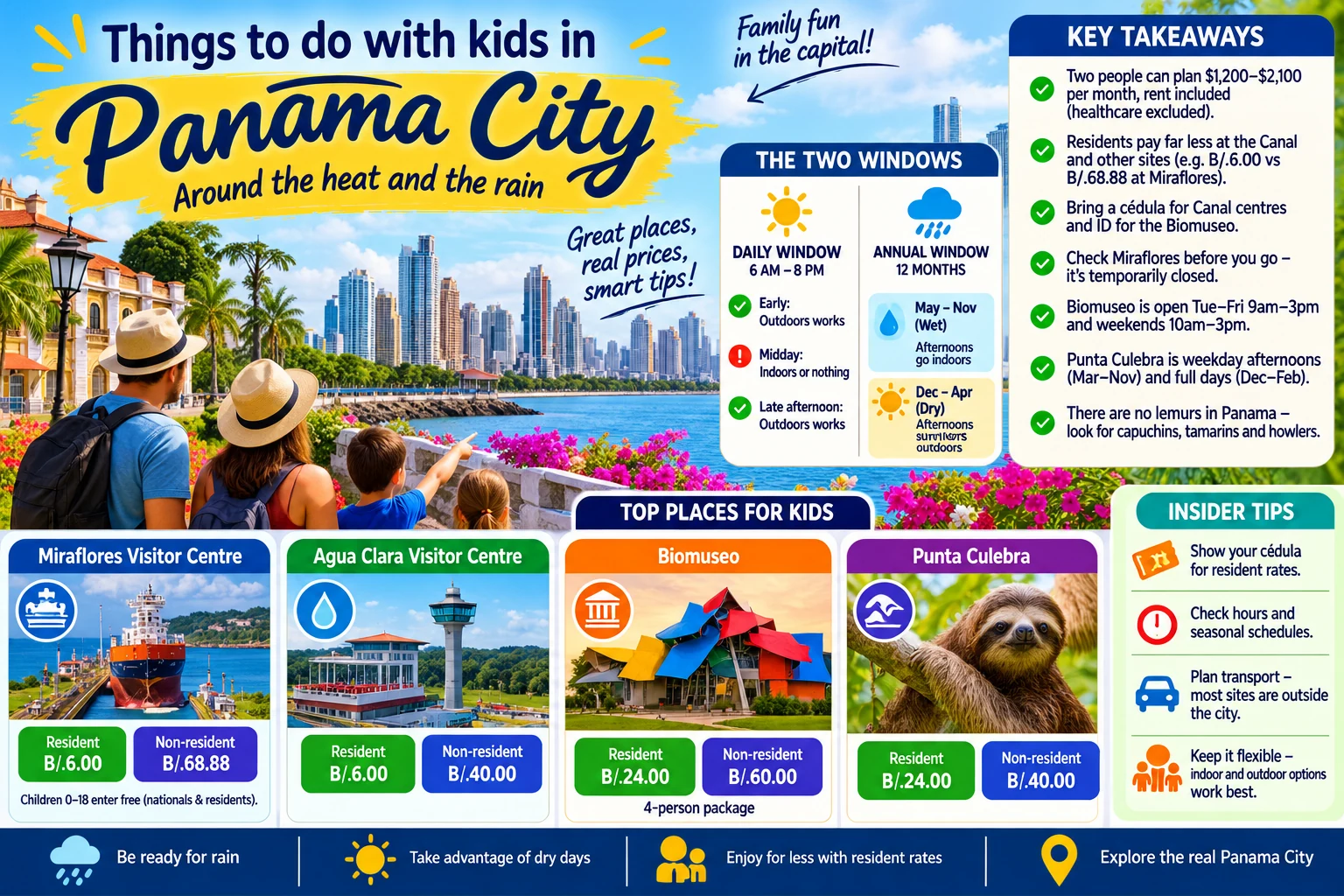
The Two Windows That Decide The Plan
Outdoors Works
Indoors or Nothing
Outdoors Works
Afternoons Go Indoors
Afternoons Survive Outdoors
Key takeaways
- Residents pay far less. At the Canal’s Miraflores centre, a family of four with two teenagers pays B/.68.88 as non-residents and B/.6.00 as residents, because children up to 18 go free on the national rate.
- Bring a cédula for the Canal centres and ID for the Biomuseo. It’s for nationals and residents. Asking nicely as a tourist won’t do it.
- Check Miraflores before you drive out there. The Canal’s own visitor site now shows it as closed for the time being.
- The Biomuseo is open Tuesday to Frida9 amam to 3 pm, and weekends10 amm t3 pmpm. Guides saying it opens weekends only are years out of date.
- Punta Culebra’s hours move with the season. It’s weekday afternoons only from March to November, then full days Tuesday to Sunday from December to February.
- There are no lemurs in Panama. A ranking guide says there are. Panama’s native monkeys include capuchins, tamarins and howlers.
- Residents disagree about whether the city has enough for children, and have done for years. The honest answer turns on whether you’ll drive.
The price break that changes the day’s cost
Each venue below that charges entry gives residents less to pay. At the Canal centres the gap is huge.
Here is what the price lists say; read this week. Every row is the same family: two adults and two children aged 13 and 15.
| Venue | Resident | Non-resident |
|---|---|---|
| Miraflores Visitor Centre | B/.6.00 | B/.68.88 |
| Agua Clara Visitor Centre | B/.6.00 | B/.40.00 |
| Biomuseo, four-person package | B/.24.00 | B/.60.00 |
| Punta Culebra | B/.24.00 | B/.40.00 |
That pairing shows the structure most clearly. The Canal list puts ages 0 to 18 at B/.0.00 for nationals and residents. A non-resident 13-year-old already pays the full adult rate of B/.17.22.
Younger children change the non-resident figure, not the resident one. With a 7-year-old and a 10-year-old, the non-resident family pays B/.48.88 at Miraflores and B/.26.00 at Punta Culebra. The resident family pays B/.6.00 and B/.18.00.
What you need at the window matters as much as the price. The Canal list asks for a Panamanian cédula for adult nationals and residents. The student rate needs a student card from a Panamanian institution. The disability rate needs a certificate from Senadis. The Biomuseo lists its resident rates “with ID.”
Two details worth knowing. Children under 5 enter the Canal centres free, but must be with an adult at all times. And at the Biomuseo the four-person package beats four singles either way. It’s B/.24.00 against B/.32.00 for residents, and B/.60.00 against B/.64.00 for non-residents.
The Resident Price Gap
Visitor Center: The ACP tariff strictly states that Panamanian nationals and residents ages 0-18 enter free. The non-resident price for ages 13+ is B/.17.22 (B/.17.22 x 4 = ~68.88). Resident adults are B/.3.00 (B/.3.00 x 2 = B/.6.00).
Agua Clara: Non-resident adults/13+ are B/.10.00. Residents are B/.3.00.
Punta Culebra: B/.10.00 for non-residents (adults/teens), B/.6.00 for residents.
Biomuseo: The 4-person package pricing (B/.24.00 for residents, B/.60.00 for non-residents) remains their standard promotional bundle. (Note: The Biomuseo resident student rate is typically B/.6.00, though they often just push the bundle for families).
Check Miraflores before you go.
The Canal’s own visitor site now shows the Miraflores Visitor Centre as temporarily closed. Its prices and hours are struck out on the page.
That matters more than any line here. Miraflores is the first thing most guides name. And it’s a half-hour drive with children in the car.
The picture isn’t clean, though. The Canal’s own tariff schedule from December 2025 still lists Miraflores prices in full. A Canal article still describes both centres as places you can buy tickets for. So one official page says closed, and another still prices it.
Call or check the site the morning you plan to go. If it’s shut, Agua Clara on the Atlantic side is the alternative. Its prices are lower for non-residents: B/.10.00 for adults and children 13 and over, and B/.5.00 for children 6 to 12. Residents pay the same B/.3.00 adult rate, with under-18s free. It’s a longer drive, so treat it as a day out rather than a morning.
While the ACP visitor portal went through a confusing period of “temporarily closed” messaging due to renovations of the IMAX theater and viewing deck expansions, the Miraflores Visitor Center itself is currently open and receiving visitors. You should adjust the text to state that while the website previously showed it as closed, it is operating, but calling ahead to confirm which specific exhibits (like the theater) are open on a given day is highly recommended.
What works early, before the heat
Mornings are the outdoor window. Be in the shade by nine, and done by noon.
Parque Natural Metropolitano is tropical forest inside the city. There are trails, and a good chance of sloths, birds,s and agoutis. It’s the nearest thing to a forest walk you can do before lunch without leaving town.
Parque Omar is the city’s main public park. It has a playground, and a Panamanian family guide notes an inclusive play area for children with disabilities. It’s flat, open, en and free to walk into, which makes it the default for a quick run.
Casco Viejo works early for the same reason. The stone streets get hot later. Children tend to like the ruins and the sea wall more than the buildings.
Punta Culebra is the one to plan properly. It’s the Smithsonian’s marine centre on the Amador Causeway, and its hours move with the season. From March to November, it opens Wednesday to Friday, 1 pm to 5 pm, and weekends 9 am to 5 pm. From December to February, it opens Tuesday to Sunday, 9 am to 5 pm. It closes Mondays, and ticketing stops at 4 pm.
So for most of the year it’s a weekday afternoon, or a weekend morning. The Smithsonian puts a visit at about an hour and a half.
It’s worth the planning. There are touch tanks with marine life, and the Fabulous Frogs of Panama exhibit. Outside there’s a sandy beach full of crabs, and a hilltop patch of forest with sloths and iguanas. The Smithsonian says about 100,000 people visit a year, most of them local school students.
Admission is B/.6.00 for Panamanians and residents, B/.10.00 for non-residents, B/.3.00 for Panamanian retirees, and B/.3.00 for children under 13. Walk-ins are fine, but entry depends on space on the day.
When Places Are Actually Open
What works at midday and in the rain
The lists skip this half of the question. It’s the half residents need most.
The Biomuseo is the strongest answer. It’s indoor, air-conditioned, and built around Panama’s natural history. It’s made for walking through rather than reading at. It opens Tuesday to Friday, 9 am to3 pm, and weekends 10 am to 3 pm.
Note those hours. It shuts at 3 pm daily, so it’s a morning or early plan. It can’t rescue a late afternoon. And it’s shut on Mondays.
You may have read that the Biomuseo opens on weekends only. That claim is years out of date, and looks like pandemic-era text nobody cleaned up. Its own site shows the Tuesday-to-Friday hours above.
A Panamanian family guide names four more indoor places. The Museo del Canal Interoceánico in Casco Viejo. The Museo Antropológico Reina Torres de Araúz. The Museo de Arte Contemporáneo. And the cinemas inside the larger shopping centres.
Note what isn’t checked here. None of those four carries a price, an age range, or opening hours on any source read for this page. That’s as true of the Spanish guides as the English ones.
Museo del Canal (Casco Viejo): Open Tuesday-Sunday 9 am-6 pm. General admission is $5.00 for non-residents and $3.00 for residents/nationals.
Museo de Arte Contemporáneo (MAC): Open Tuesday-Sunday 10 am-5 pm (Thursdays until 8 pm). Admission is “pay what you can” (suggested donation $5).
Museo Antropológico Reina Torres de Araúz (MARTA): Action Required: You should remove MARTA from your list. It has been closed for years undergoing a massive, endlessly delayed restoration project and is not currently an option for a weekend family visit.
The mall question needs an honest answer. One 2008 resident report, quoted further down, put weekend activities in the malls and blamed the midday heat. Malls really are the default wet-season afternoon here. The ones with cinemas and play areas are doing real work for families. They answer a real need on the day. That isn’t a failure of imagination.
Boat trips, water and the things to check first
The Gatún Lake boat trips are the most popular paid family outing after the Canal itself. They’re also where the printed information is worst.
Start with a correction. One ranking guide lists lemurs among the animals you’ll see. There are no lemurs in Panama, or anywhere in the Americas outside a zoo. Lemurs live in Madagascar. Panama has nine native monkey species. They include the Panamanian white-faced capuchin, Geoffroy’s tamarin, and the mantled howler. Those are the kinds of primates the region actually holds.
The same guide claims capuchins choose their own food and medicines. Don’t plan a lesson around it. Nothing read for this page supports it.
On safety, these claims belong to the operator rather than to a guide. The booking site Hellotickets makes four such claims. Children and babies should sit on an adult’s lap on the Monkey Island boats. Bike tours want children at least 11, with some height limits. Zip-lining usually has no age or height limit, but should be checked. And Taboga Island is unsuitable for babies under six months, and needs passports for the whole family.
Treat each one as a question to ask when you book. Don’t lean on it as fact. These are the claims a parent acts on with a child in a boat. They need to come from the company running the boat.
Two standing rules, whatever you book. Children near water need an adult watching, and many beaches near the city have no lifeguard. And don’t feed or handle wildlife, however close the boat gets.
One note on prices. Two of the three top guides are built around booking links. Their prices are package prices for a tour, not gate admission, and those are commercial listings. The Canal list shows why the two differ. A registered tour operator buying at least 25 tickets pays B/.15.22 per non-resident adult at Miraflores, against B/.17.22 at the gate.
And treat any price with no currency as unusable. One ranking guide prices a water park “from 9 euros.” The page is set in pounds. The country uses the US dollar.
Does Panama City have enough for children?
Residents have disagreed for nearly twenty years. That disagreement is the honest answer.
Dated resident reports on Talesmag run the whole range of views. January 2013: “It’s a great place for families as there is so much to do here with kids.”
September 2011: “For families, it is good as well, but you may need to be creative about entertainment options,” with few museums but plenty of sport.
May 2008: weekend activities “limited to walking the malls.”
April 2008: “Not for families,” citing traffic and costs.
December 2021: “Good for all. I would suggest a house if living with kids so they have space to move around.”
Some of that spread is just age. A 2008 verdict on the city’s museums describes the city as it was then, not as it is now. But some of it is real disagreement, among people living in the same place at the same time.
Read together, they point at two things. Whether you’ll drive out of the city at weekends. And whether your children have outdoor space at home, rather than needing to be driven somewhere to run.
A 2014 report on Talesmag recommended Albrook and Clayton for families. It described many children nearby, a suburban feel, and neighbours’ children on bikes. It advised against El Dorado and Dos Mares, citing few safe play areas. That’s one resident’s view, and it’s twelve years old now. Neighbourhood choice needs fresh sources.
Filling fifty-two weekends
The named attractions cover maybe six weekends. Here’s the structure for the rest.
Rotate by window. Keep two or three outdoor mornings you can repeat. Children will happily redo a park they like. Keep one or two indoor places in reserve for wet afternoons. Add one bigger outing a month that needs a car.
Use the resident rate hard. At B/.3.00 an adult, with children free, the Canal centres are cheap enough for a routine Saturday. Not a once-a-year outing. The same goes for Punta Culebra at B/.6.00.
Treat the dry season differently. Punta Culebra’s full-day hours run December to February only. That’s also when outdoor plans survive the afternoon. The calendar does more work here than the list of venues.
A resident family’s actual rotation: Living in Panama City with two children under eight, you quickly realize you cannot treat the city like a tourist on a 52-week loop. Our standard dry-season rotation leans heavily on Parque Omar early on Saturday mornings (arriving by 7:30 AM before the sun gets vicious), followed by grabbing breakfast at a nearby panadería. Once a month, we utilize the B/.6.00 resident rate at Punta Culebra, specifically timing it for Sunday mornings.
The real test is October and November. When the afternoon thunderstorms roll in reliably at 2:00 PM, we completely abandon outdoor ambition. We keep Albrook Mall or Multiplaza in reserve specifically for these months, not for shopping, but because the air-conditioned arcades, cinemas, and indoor play structures are the only way to burn off energy when the streets are flooding outside. We gave up entirely on afternoon Casco Viejo visits; pushing a stroller over hot brick while dodging sudden downpours ceased being fun after exactly one attempt.
What you’ll have to check yourself
Four facts here move faster than any page keeps up with. They’re also the four a parent most needs. Whether Miraflores is open now is unclear, and two official pages disagree. Prices and hours at the three museums above are unchecked, because no source read for this page printed any. Every age and safety limit on the boat and bike trips is the booking site’s claim, not the operator’s. Whale-watching season is sometimes given as July to October, with August best, plus a smaller season from December to February. Nothing read for this page confirmed it. So it isn’t offered here as a fixture.
There’s a limit of method too. All of it was read inside one week, and venue data goes stale fast. The line below says when.
Firmer ground: the Canal price list and the proof it asks for. The Biomuseo’s prices and hours. Punta Culebra’s prices and seasonal hours. No lemurs. And the sums in the family table.
Venue prices, hours and age limits change often, and some of the figures here carry a verification note. Check the venue’s own site or call before you travel, especially if the trip involves a drive with children.
Questions parents ask
How do I tell whether a guide is about the wrong Panama City?
Look for the Canal, Casco Viejo or the Biomuseo. If a page mentions beach condos, a boardwalk, or spring break, you’re reading about Florida. Prices in euros or pounds are another tell, since Panama uses the US dollar.
What’s the best thing to do with young children?
On checked prices and hours, Punta Culebra. Touch tanks and a crab beach suit small children better than a museum. A visit runs about an hour and a half, and it costs B/.3.00 for under-13s, regardless of your residency. Check the season first, because weekday opening is afternoons only from March to November.
Do we really get the resident price?
If you can show the documents, yes. The Canal asks for a Panamanian cédula for the national and resident rate. The Biomuseo lists its resident prices with ID. A tourist passport won’t get you the local price.
What do we do when it rains all afternoon?
Accept that this is the city’s weak spot for children and plan around it rather than improvising. The indoor options that stay open late are the mall cinemas, because the museums close early. Keeping one indoor place in reserve, unvisited, is worth more than a longer list.
Is Monkey Island worth it with a toddler?
The boats are the issue rather than the monkeys. The booking site says babies and small children should sit on an adult’s lap. That’s the kind of thing to confirm with the firm before you pay. Ask about life jackets in child sizes at the same time.
Last verified: 13 October 2026. Reviewed every three months, and sooner for the Miraflores status.

Abakwa Studio is the publishing team behind Lifestyle Panama, with a background in advertising technology. Our guides are drafted with AI assistance and then reviewed by our editor, Muhammad Shoaib, who has experience working as a visa agent in Pakistan. For visa, residency and tax topics, we check our guides against official Panamanian government sources. They are general information, not legal or tax advice.

