
You said good morning to a neighbour, and something felt off. Or a worker said thirty minutes and turned up two hours later. Or someone’s face changed when you used the wrong word, and nobody told you why.
When it comes to Panama cultural norms, most of what reads as rude is short, specific, and easy to fix.
The harder problem is the advice. One guide says Panamanians value personal space. Another says they stand closer than you are used to, and that stepping back looks unfriendly. Both pages rank well. Neither names a source for a single cultural claim, and one of them carries no date at all.
They clash because they give flat rules for norms that bend. Nearly every item below has one thing that settles the answer: how well you know the person, whether the setting is social or work, their age, or where in the country you are. Learn the deciding thing, and you can stop memorising lists.
Key takeaways
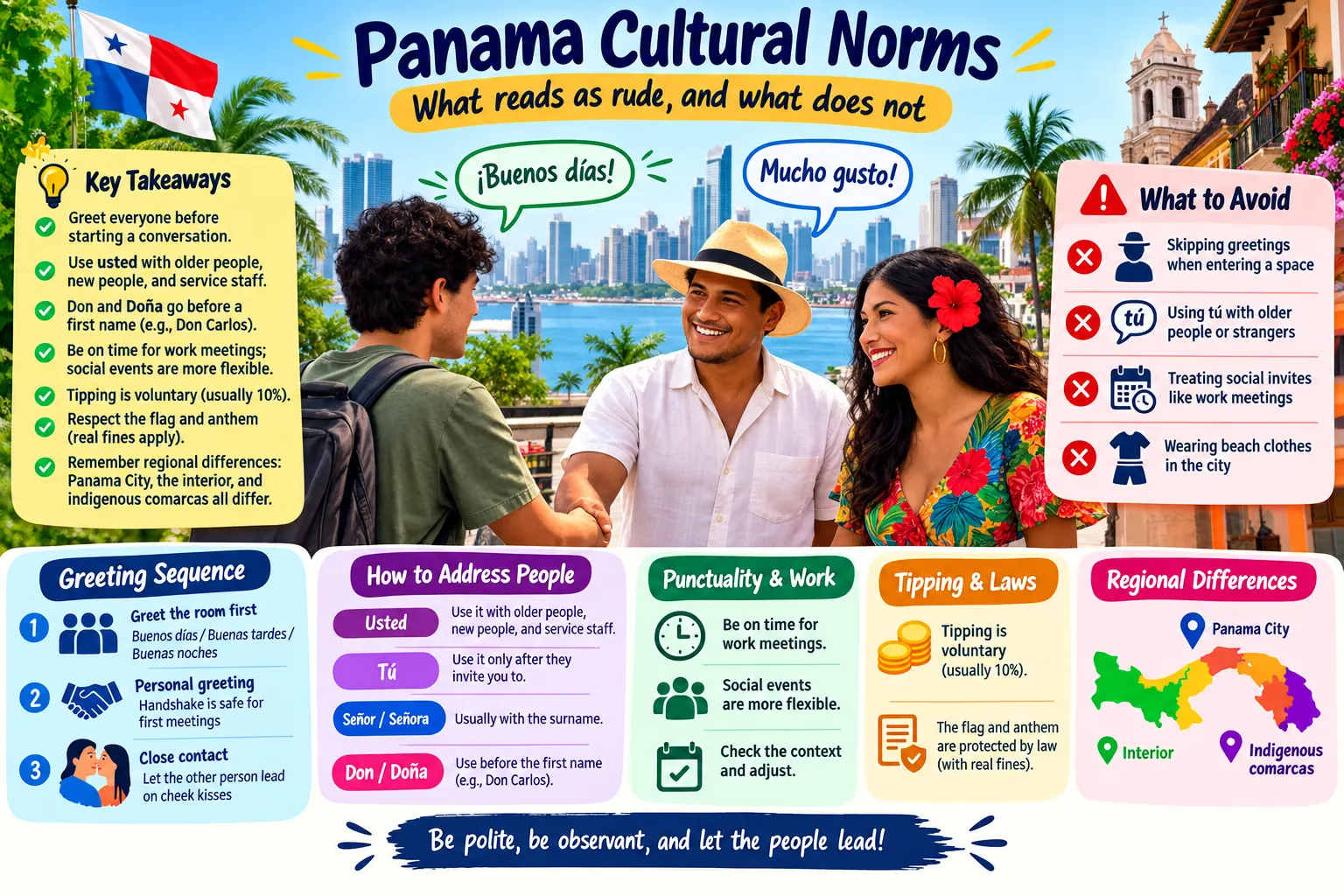
- Greeting everyone present before you start talking buys more goodwill than anything else on this page.
- Use usted with anyone older, anyone you just met, and anyone serving you, until they switch you to tú.
- Don and Doña go in front of a first name, never a surname. Don Carlos, not Don Pérez.
- Work meetings should start on time. Social events need not, and the two guides give different windows for how late is fine.
- A tip is voluntary under Panamanian consumer law, and no restaurant can force one. Most places suggest 10%.
- The flag and the anthem are covered by a law with real fines, so that one is not just manners.
- Panama City, the interior, and the indigenous comarcas differ. The comarcas have their own written rules.
What really reads as rude here
Four things cause most of the trouble. Walking into a space without greeting anyone. Using the familiar tú with an older person or a stranger. Treating a social invite like a work meeting. Wearing beach clothes in the city.
None of them need good Spanish. All of them are about noticing the other person first.
Being direct is the pattern underneath. Many North Americans and Europeans open with the task: the question, the complaint, the request. Here the greeting comes first. Skipping it to save time reads as treating a person like a service desk.
Getting Spanish wrong is not the problem you think it is. If you do want to improve, our guide to learning Spanish in Panama shows where most people stall. A badly said buenos días lands far better than perfect grammar with no hello attached. One expat quoted on the top-ranking English guide put it this way: “Panamanians are very tranquilo people and willing to help. If you are politely sincere, they will overlook any faux pas.”
Greetings: the hello you cannot skip
Greet the room, not just the person you came to see.
Walk into a small shop, a waiting room, a lift, or an office, and the move people expect is one broad hello. Say buenos días before noon, buenas tardes in the afternoon, and buenas noches after dark. You say it to no one in the room and to all of them at once.
That one habit does more for you than anything else on this page. It costs two words.
Who you touch depends on who they are. The English guides agree on this much. Men shake hands with men. Women greet women with a light kiss on the cheek. A man and a woman who know each other may do the same. For a first work meeting, a handshake is the safe bet.
Those guides name no source for any of it. No official or academic source turned up in research for this page either. So treat the touching rules as what foreign writers tend to report, not as proven fact. The safe method is simple. Let the other person lead, and follow what they offer.
Greeting Sequence on Entering a Space
Greet the room:
Buenos días / Buenas tardes / Buenas noches
Let the other person lead on cheek kisses.
What do you call people?
The two most-read English guides each give you half of this system, and the halves do not overlap. One explains using usted until you are asked to use tú, and never mentions titles. The other explains Señor, Señora, and Licenciado, and never mentions usted or tú. Neither mentions Don or Doña.
Here is the whole thing in one place.
Usted or tú
Usted is the respectful form. Tú is the familiar one.
Start with usted for anyone older than you, anyone you have just met, anyone in a work role, and anyone serving you. Wait for them to move you to tú, then follow.
The Real Academia Española notes that the tú form is more common in Spain than in the Americas. That points one way for a new arrival. Starting formal is cheap. The other way round is not.
Señor, Señora, and work titles
Señor and Señora normally go with the surname. Señorita now means a young woman, or a woman in certain jobs, whatever her age, so it is easy to get wrong and easy to skip.
Job titles matter more here than you would expect. Licenciado and Licenciada are used for university graduates. Doctor, Doctora, Ingeniero, and Profesor work the same way. The Real Academia Española lists these as titles that sit in front of the name, written in small letters, with capital short forms like Lic. and Dra. If a business card or an email signature carries one, use it.
Don and Doña
Here is the part neither guide carries, and the part most people get wrong.
Don and Doña are respectful and a little warmer than Señor. They go in front of the first name. The Real Academia Española says so plainly: “En el español general actual se antepone don/doña al nombre de pila.”
So an older neighbour called Carlos Pérez is Don Carlos. He is not Don Pérez.
| What you want to say | Use | Goes with |
|---|---|---|
| Respect for an older person you know a little | Don / Doña | A first name: Don Carlos |
| Formal respect for someone you just met | Señor / Señora | A surname: Señor Pérez |
| Respect for a graduate or professional | Licenciado, Doctor, Ingeniero | The name, title in small letters |
| Speaking to almost anyone at first | usted | The verb, not a name |
| Speaking to a friend, or once invited | tú | The verb, not a name |
Forms of Address Decision Path
Standing distance: why your two guides disagree
The biggest study of conversation distance left Panama out. That is why no one can give you a number.
The study is Sorokowska and colleagues, in the Journal of Cross-Cultural Psychology, 2017. It covered 42 countries. Argentina, Brazil, Colombia, Mexico, Peru, and the United States were in it. Panama was not. So anyone stating a norm here as fact is not working from a measurement.
Read the two clashing rules again, and they turn out to be about two separate things. One tells you to “be mindful of how close you stand to others.” That is a manners rule, and it would hold anywhere. The other says Panamanians “tend to stand closer when speaking” than North Americans or Europeans, and that stepping back too much “may be perceived as unfriendly.” That is a claim about the local habit. You can hold both at once. Expect less space than you are used to, and still do not crowd anyone.
In practice, let the other person set the distance, and do not step back sharply. That is a method, not a number. No number is on offer.
“Panama time”: there are two clocks
Work runs on the clock. Social life does not.
Both guides agree on this split, and it is the part you can lean on. Meetings should start on time, and turning up late to one reads as sloppy.
For social arrivals, the guides do not agree. One puts acceptable lateness at 15 to 30 minutes. The other puts it at 30 to 60. Neither backs up its window, and splitting the difference would invent a figure neither source supports.
What settles it is the event, not the country. A sit-down meal where someone is cooking has a real time attached. A party or an open house does not, and arriving exactly on the hour can mean arriving before your host is dressed. If it matters, ask the host what time people will really eat.
Service calls are a third thing, and this is where new arrivals get angriest. A time quoted by a driver or a tradesperson is a guess, not a social window. One poster in a long expat forum thread, now about eleven years old, was told “I will arrive in 7 minutes” and then waited far longer. Told fifteen minutes another time, they waited about ninety.
That thread is old. Read it for the shape of the anger, not as a current account of service here. Other posters pushed back at the time. One told the writer that “nothing was right about your reaction and expectations.” Expats do not even agree with each other on what the norm is. The useful move is to check rather than wait. Ask where the person is now, and plan your hour around a guess.
When I first moved to Panama City, an AC repair technician told me via WhatsApp he would arrive “en 20 minutos.” Two hours later, I was still waiting by the door. When he finally arrived, he wasn’t apologetic—because to him, he wasn’t ‘late’; he had simply been delayed by a prior job and city traffic. The quote was an expression of intention, not a schedule.
What I do differently now: I no longer clear my morning to wait by the door. Instead, I wait until the quoted time has passed, and then I message to ask, “¿Por dónde vienes?” (Where are you right now?). Asking for their physical location yields a much more accurate timeline than asking for an ETA.
What to wear, and where
Clothes read as a statement about where you think you are.
Panama City is a business city, and it dresses like one. Shorts, flip-flops, and swimwear belong at the beach or in genuinely casual places. Wearing them into a city office, a bank, or a restaurant marks you as a tourist in a place where you live.
For work, business casual is the normal floor. In public generally, light but modest clothing is the normal expectation.
Swimwear away from the water is the clearest line of all. In Guna Yala it is not a matter of taste. The Congreso General Guna’s own tourism rules ban walking through community streets in swimwear, and ban nudity on the island beaches.
Invitations: what happens when someone asks you over
An invite to someone’s home is a real step in a friendship, and treating it lightly is costly. Accept, turn up, and bring something small.
Expect to be fed more than you planned to eat, and to stay longer than you planned to stay. That warmth is part of the point.
One story on the top-ranking English guide shows how far house customs can sit from a newcomer’s instincts. An expat gave a raise to a domestic worker. It “caused quite a stir amongst the neighbors,” they wrote. They added that “Inviting the ‘help’ into the house and sharing the midday meal was also considered a no-no.” That expat kept sharing lunch anyway.
The story has no date and no stated method, and it is one person’s account. So read it as a sign that hiring help at home comes with local customs worth asking about. Do not read it as a rule to copy.
For my first invitation to a Panamanian neighbor’s home for a Sunday sancocho, I made three classic newcomer mistakes. First, I arrived exactly at 1:00 PM, the time stated. I was the first one there by almost an hour, and the host was still prepping the kitchen. Second, I brought an expensive bottle of wine, which felt awkwardly formal compared to the relaxed six-packs of national beer others brought later. Finally, I expected to eat and leave within two hours. Instead, I learned the value of sobremesa—the hours spent sitting around the table talking and drinking long after the plates are cleared.
The lesson: If you are invited to a casual weekend meal, arrive 30 to 45 minutes after the stated time, bring something modest meant to be shared immediately (like dessert or drinks), and do not make other plans for the rest of your afternoon.
Subjects to let Panamanians raise first
Politics is the obvious one, and both guides say so. Two other subjects need more care than a general warning gives them.
The 1989 United States invasion is living memory, not the past, and views on it are not the same from person to person. Some Panamanians welcomed the removal of Manuel Noriega. Others lost family, homes, or whole neighbourhoods. A newcomer who opens the subject at a first meeting is asking a stranger to take a stand on the worst week of their family’s life. Let it come up on their terms.
Race and ethnicity carry their own past here, and some words you will hear in casual speech are argued over. Repeating a word because you heard someone else say it is how newcomers offend without meaning to. Do not pick up slang about groups of people.
Money is a third and milder one. Asking what someone earns, or what their home cost, lands badly in most settings.
The flag and the anthem are law, not manners.
One expat quote on the top guide warns against disrespecting the flag, emblems, and customs. It calls that “a serious offense.” The quote names no source. For the flag and the anthem, it is still right. That part is written into law.
The law is Ley 34 of 1949. It now reads in a combined text that folds in the changes made by Ley 2 of 23 January 2012. The Ministerio de Gobierno puts out that text through the Comisión Nacional de los Símbolos de la Nación. It names no later change.
The law bans burning a flag. It also bans treating one in a disrespectful or irreverent way, such as mockery or protest. And it sets fines. Breaches with no set penalty run from B/.50 to B/.500. Some named breaches cost more. Mayors hear the cases in their own districts. Anyone can report one to the police. Fines in Panamanian law are written in balboas, shown as B/.
The anthem carries a duty too. When it plays at a formal event, people nearby should stand at attention and stay quiet. Men should take off their hats. People with a disability are exempt.
This section reports what the law says. It is general information, not legal advice, and the published law itself controls in any real case.
There is history behind this, and it explains why the flag is not a neutral object. On 9 January 1964, students from the Instituto Nacional went to a school inside the then Canal Zone to raise the Panamanian flag alongside the American one, under an agreement. American residents of the Zone resisted them. The Panamanian flag was torn in the clash, and Panamanians were killed in the days that followed. Panama remembers the date as the Día de los Mártires. The flag here is tied to sovereignty, which is why the law reaches further than politeness would.
The substantive facts are correct. Ley 2 of 2012 (modifying Ley 34 of 1949) establishes fines ranging from B/.50 to B/.500 for disrespecting national symbols, with enforcement falling under the jurisdiction of the alcaldes (mayors). The mismatched article numbering between the Gaceta Oficial’s raw reform text and the compiled administrative text is a known quirk, but it does not change the law’s application or penalty limits.
Tipping is voluntary, and that is official.
A tip here is voluntary, and no business can force one. That is not a guess about culture. It is the stated view of Panama’s consumer watchdog, ACODECO.
Jaime Guzmán heads the agency’s investigation unit. He put it plainly: “El agente económico puede sugerir la propina, pero su pago no es obligatorio.” A business may suggest a tip. Paying it is not required. ACODECO rests this on the price rules in Ley 45 of 2007, as changed by Ley 34 of 2 August 2016.
Three things follow:
- The usual suggestion is 10%. No rule sets an amount, ACODECO says, and 10% is what most places suggest. The main English guide calls 10% customary, which fits.
- Some bills suggest a good deal more. ACODECO has seen suggested tips as high as 30% in some places.
- A tip sitting on your total is still your choice. A tip cannot be built in ahead of time. Where one shows up in the total, ACODECO says the customer decides whether to pay it.
Read the bill before you pay. Many complaints to ACODECO come from totals that do not split the food from the suggested tip.
Juega vivo: what the research says, and what it does not
You will hear juega vivo sooner or later, often from a foreigner explaining Panama to you. The scholars who study it do not agree on what it means, and the version handed to you is usually one reading dressed up as the whole picture.
Gabisell Barsallo Alvarado weighs both in the University of Panama journal Cátedra, in 2021. One set of writers treats the idea as graft and self-dealing. She quotes Saad calling it “the perfect recipe for failure as a society.” Others in that group call Panama a transactional society. A rival reading treats it as getting by under pressure. For that one, she cites Joseph Garzón, who calls it “an impulse to the pro-activity of humble, poor, in short, dispossessed people.”
Two gaps in that paper matter more than either reading. It offers no survey data on what people here think of the idea. And it does report a view of Panamanians as lazy or unwilling to work. But it ties that view to how some migrants and foreign writers see them. Not to how Panamanians see themselves.
So the safe ground is narrow. The phrase exists, scholars here argue over it, and it is not a sketch of the character of the people around you. Reach for it to explain a late appointment, and you earn what one expat on the ranking guide called “jerk treatment” in return.
Panama City is not Panama.
Nearly all English-language etiquette advice for Panama is about the capital, then treated as the whole country. Dress is stricter in the city than in the interior. Greetings are warmer and slower in small towns than in a Panama City lift.
The indigenous comarcas are not the same thing at all. They are not a local version of Panamanian custom, and they have their own authorities and their own written rules. Guna Yala’s tourism rules come from the Congreso General Guna, which has its own board and tourism office. Those rules carry fines from $100 to $1,000.
Parts of them speak directly to how a visitor behaves. Photos and filming need express leave from local authorities. The rule says so in these words: “no estará permitido tomar fotos ni filmar sin el permiso expreso de las autoridades locales.” Visitors are told to respect the cultural life of the community they visit, cemeteries and ritual days included. Throwing coins, objects, or food is banned.
That photo rule sits in the part written for visiting boats and their crews. So do not read it as the only rule, or as covering every visitor the same way. Read it as the clearest signal of what is wanted. Ask first. And expect the answer to rest on somebody’s written rules rather than on your own judgment.
How much to trust any etiquette guide, including this one
Five things on this page rest on facts you can check:
- the law on national symbols
- ACODECO’s stance on tipping
- the forms of address backed by the Real Academia Española
- the Guna Yala tourism rules
- The Barsallo paper on Juega Vivo
All five are listed as sources below.
The rest is what foreign writers tend to report. That covers most of the greeting and welcome advice here. It is probably broadly right. It has not been shown, and this page will not pretend it has.
Which leaves one piece of advice that works everywhere. Watch what the person in front of you does, and copy it. Local habit beats any list, this one included.
Questions newcomers ask about Panama cultural norms
Is tú rude with someone your own age?
Usually not, once you have met properly, and less so in casual settings. Starting with usted and being moved to tú costs you nothing. The error that is hard to walk back is the other way round.
Do you need Spanish to be polite here?
No. The greeting matters more than the grammar. A mispronounced buenos días with eye contact does the job. Perfect Spanish with no hello does not.
Shake hands, or kiss the cheek, on a first meeting?
Offer a handshake and let her adjust it. The guides describe a light cheek kiss between women, and between a man and a woman who already know each other, but none of them shows evidence for it. Following the other person’s lead is the reliable method.
Can you refuse a tip that is already on the bill?
Under ACODECO’s stated position, yes. A tip cannot be added as an obligation, and where one appears in your total, the decision to pay it is yours.
Is taking photos a problem?
Ask first, above all, with people. In Guna Yala, permission from local authorities is written into the comarca’s own tourism rules and backed by fines.
Last verified: 10 October 2026.
Verification provenance, per Part 9.8: the national symbols law was read on 10 October 2026 in the Asamblea Nacional text of Ley 2 de 2012 and cross-checked against the Ministerio de Gobierno’s combined-text page, which names no later amendment. ACODECO’s tipping position comes from an Infobae report dated 20 May 2026 quoting a named ACODECO official, not from an ACODECO page read directly, because the authority’s own notice would not load. Forms of address were checked against the Real Academia Española’s own guidance. The Guna Yala tourism rules were read on the Congreso General Guna site, which carries a 2017 footer. The interpersonal-distance study is Sorokowska et al. 2017, and its 42-country list was read directly. The events of 9 January 1964 were checked against a TVN-2 account citing historian Luis Navas Pájaro. Both competing etiquette guides were read on 10 October 2026, and one carries no publication date.

Abakwa Studio is the publishing team behind Lifestyle Panama, with a background in advertising technology. Our guides are drafted with AI assistance and then reviewed by our editor, Muhammad Shoaib, who has experience working as a visa agent in Pakistan. For visa, residency and tax topics, we check our guides against official Panamanian government sources. They are general information, not legal or tax advice.

