


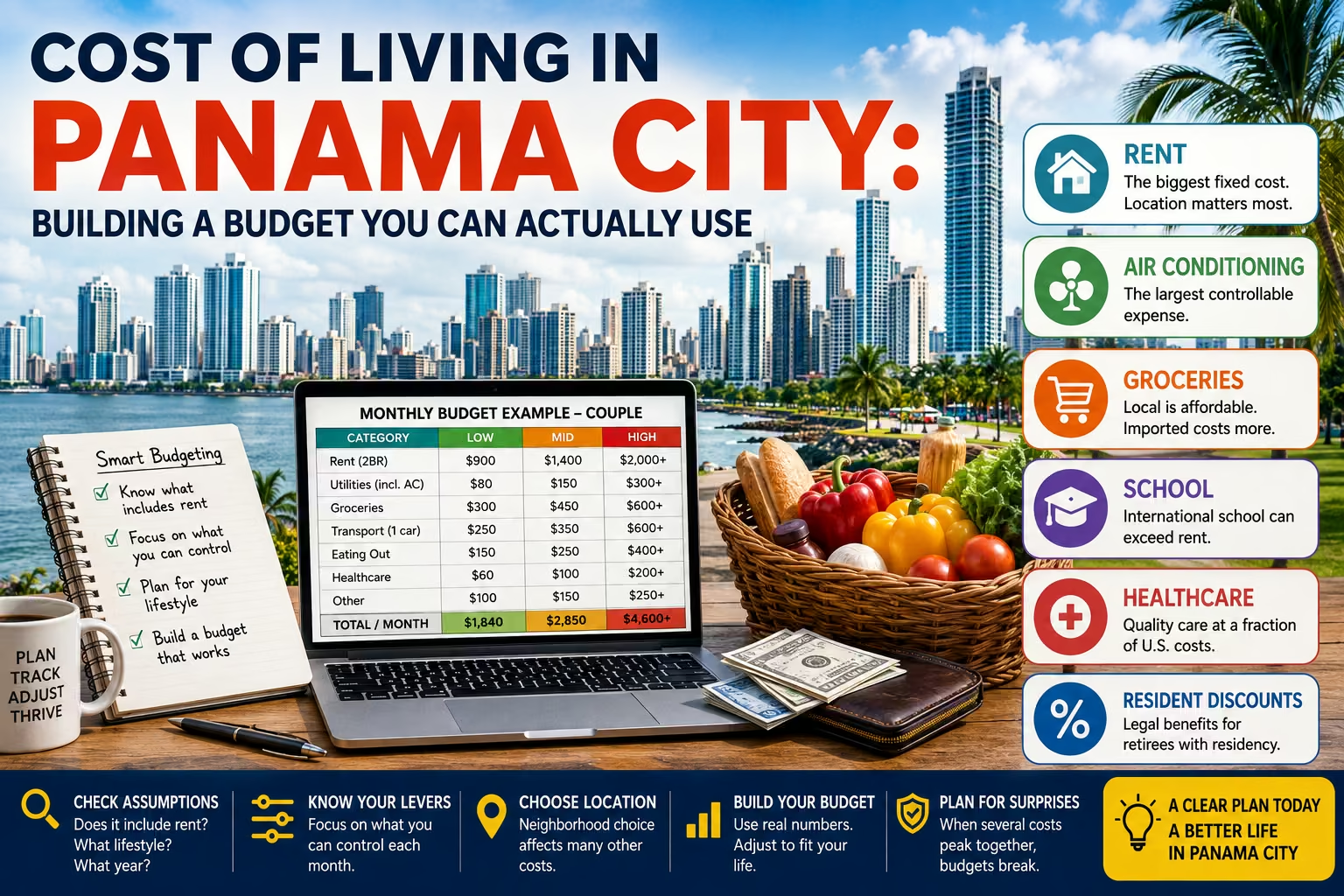
Cost of Living in Panama City: Building a Budget You Can Actually Use
You have probably found five totals somewhere between $700 and $6,500 a month and no way to tell which describes you. That spread is not because sources are careless. It is because most of them never say whether the figure includes rent, and rent is the largest single line in almost every household here.
So the first rule for reading any Panama City budget, including this one: check what it includes before you compare it to anything.
The second thing worth knowing early is that the biggest controllable line is not rent, groceries, or restaurants. It is air conditioning. One reported household saw a first hot-season bill of $290 running AC continuously, then roughly halved it by using ceiling fans in the day and bedroom AC only at night. That single habit moves more money than most people’s entire grocery variance.
This page gives you three worked budgets with every assumption declared, explains why published totals conflict, and points to the detailed guides for each line rather than re-deriving them here.
Key takeaways
- Always check whether a quoted total includes rent. If you are deciding whether to stop renting altogether, see the break-even math on buying versus renting, and for a highland comparison, see Boquete’s cost of living. A $700 figure and a $2,500 figure often describe the same lifestyle.
- Air conditioning is the largest controllable swing, reported at $30 to $70 a month for light use against $100 to $250 or more for heavy use.
- Utilities scale with floor area and AC habit, not with headcount. A couple does not cost double a single.
- International school can exceed rent. Reported at roughly $1,000 to $1,800 or more per child per month.
- Official inflation is not your inflation. The national rate tracks a basket weighted toward local goods.
- The local basket is cheap, and the imported basket is not. Which one you shop from is a personal choice with a large monthly consequence.
- Retirees with residency get a legally mandated discount schedule that reaches many recurring categories.
- Every figure below carries its source and whether it includes rent. Most published budgets carry neither.
Why no two published totals agree
Four reasons, and once you can spot them you can read any figure you find.
Some include rent,t and some do not. This is the big one. A source quoting $700 a month for a single person is describing living costs after housing. A one-bedroom in the city centre has been reported at around $1,023, and outside the centre at around $795. Add either to that $7,00 and you get a completely different number, which is exactly why the published range is so wide.
Lifestyle assumptions go undeclared. “A single person needs $1,200” tells you nothing unless you know whether that person runs air conditioning all day, drives, shops imported brands, or eats out four nights a week. All four are large lines, and none is implied by the total.
Household size is applied as a multiplier. It does not work that way here. Utilities track floor area and cooling habits rather than the number of people, so a couple’s total is not twice a single’s. Groceries scale roughly with headcount, rent barely does, and electricity may not at all.
The figures are from different years, and prices moved. See the inflation section, which is a bigger problem for foreign residents than the headline rate suggests.
How to read any total you find. Ask three questions: does it include rent, what lifestyle does it assume, and what year is it from? If a source does not answer all three, you cannot compare it to your own numbers or to anyone else’s.
Lines you fix once, lines you steer
Budgets here behave differently depending on whether a line is set by a decision you make once or by what you do every day. Sorting them this way is more useful than sorting by size, because it tells you what you can still change.
Fixed when you choose, then largely locked:
- Rent, set by neighbourhood and unit size. The dominant line, and it sets the floor for several others.
- HOA fees, reported at roughly $120 to more than $400, driven by the building rather than by you.
- School, once a child is enrolled.
- Car ownership, a decision more than a monthly variable once you own one.
Steerable month to month:
- Air conditioning, the largest controllable line in the budget.
- The grocery basket, specifically how much of it is imported.
- Eating out.
- Household help, cheap enough here to be a genuine lifestyle choice rather than a luxury.
The practical implication: if your total is higher than you planned, the fixed lines are where the money is, and the steerable lines are where the change is possible. Trying to fix a fixed line usually means moving.
Panama Budget Levers: Structural vs. Behavioral
Sorting expenses by how much ongoing control you have over them.
- Base Rent: $795 – $2,500+ (sets spatial footprint)
- PH / HOA Fees: $120 – $400+ (building-dictated)
- Private Tuition: $1,000 – $1,800/mo per child
- Vehicle Debt & Insurance: Fixed monthly burden
- Air Conditioning: $30 (selective) vs $250+ (24/7)
- Grocery Sourcing: Local markets vs import grocers
- Dining Frequency: Local fondas ($5) vs Casco ($40+)
- Domestic Help: $15 – $25/day (completely optional)
The line that sets the other lines
Rent is the biggest number in most of these budgets, and treating it as one number among many understates what it does. Where you live sets the floor for several other lines at once, which is why two households with identical incomes can diverge from the moment they sign a lease.
Choosing a higher tier typically brings a larger unit, which raises the cooling load whether or not more people live in it. It usually brings a building with more amenities, which raises the HOA. It often sits further from the metro, which pushes you toward a car. And it tends to be surrounded by expat-facing shops and restaurants, which quietly shifts the grocery basket toward imported brands.
None of those is automatic, and all of them are avoidable, but they arrive together often enough to be worth naming. A jump of a few hundred dollars in rent frequently carries a further few hundred behind it, spread across lines you did not consciously choose.
Two smaller decisions behave the same way.
A car is genuinely optional here in a way it is not in most metro areas, because the city is dense and the metro is inexpensive. That makes car ownership a lifestyle line rather than a fixed cost of living, and it is one of the few large lines a household can remove entirely rather than trim.
Household help is cheap enough to change how you live, not just what you spend. That cuts both ways in a budget: it is an added line, and for some households it replaces the reason they wanted a second car or a larger appliance budget.
Rent by area belongs to our rent by neighbourhood guide, which is the number to fetch before anything else on this page is usable.
Three budgets with the assumptions stated
Every figure below names its source and states whether rent is included. Where a line is an estimate rather than a published figure, it says so.
These are illustrations of how the lines combine, not recommendations, and none is a prediction of what you personally will spend.
Budget A: single person, local-leaning, no car
Rent included: yes.
| Line | Monthly | Basis |
|---|---|---|
| Rent, one-bedroom outside the centre | ~$795 | Published city average |
| Electricity, fans by day and bedroom AC at night | $30 to $70 | Published light-use range |
| Other utilities, water, internet, phone | Estimate | See our utilities guide |
| Groceries, mainly local basket | Estimate | See our grocery costs guide |
| Transit, metro and bus | Low | Metro fares reported at around 35 cents |
| Basic health cover | From ~$20 | One membership option launched April 2025 |
Where it lands: the bottom half of the published single-person ranges, which run roughly $1,200 to $2,200 and $1,500 to $2,500 depending on source.
What makes it work: no car, light AC, a local grocery basket. All three are behavioural.
Budget B: couple, mid-range, one car
Rent included: yes.
| Line | Monthly | Basis |
|---|---|---|
| Rent, one-bedroom in the city centre | ~$1,023 | Published city average |
| HOA | $120 to $400+ | Published range, building dependent |
| Electricity, moderate to heavy AC | $100 to $250+ | Published heavy-use range |
| Groceries, mixed local and imported | $350 to $550 | Published couple range |
| Car, running costs | Varies | See our transport guide |
| Health cover | Varies | See our health insurance guide |
Where it lands: consistent with published couple ranges of roughly $2,000 to $3,500.
The instructive part: the gap between the low and high end of this same table is over $700 a month, and almost all of it sits in electricity and groceries. Two couples in the same building can be $700 apart with no structural difference.
Budget C: family, two children in international school
Rent included: yes.
| Line | Monthly | Basis |
|---|---|---|
| Rent, family-sized unit | Varies | Larger than the figures above; see our rent guide |
| Tuition, two children | $2,000 to $3,600+ | Reported at $1,000 to $1,800+ per child |
| Electricity, larger space, heavy AC | $150 to $300 | Published city range |
| Groceries, family, part imported | Above the couple range | See our grocery costs guide |
| Car or two | Varies | See our transport guide |
Where it lands: consistent with published family ranges of roughly $4,000 to $6,500 or more.
The point of this table: tuition alone can exceed rent. For a family, school is not a line in the budget; it is the second rent. For weekends with children, see our list of family activities in Panama City. Annual tuition has been reported averaging around $9,748 with a range of roughly $6,000 to $20,000, which is a wide enough spread that the school choice is a bigger budget decision than the neighbourhood.
- Methodology & Source Disclosure: Real estate agency summaries typically quote rent figures from luxury waterfront developments (Punta Pacifica, Avenida Balboa) where commissions are highest, distorting typical costs upward.
- The figures above are cross-verified against median non-promotional transaction listings on Encuentra24 and public utility tariff tables from ASEP (Autoridad Nacional de los Servicios Públicos).
- Transit fares reflect official Metro de Panamá rates ($0.35 standard, $0.50 Line 2 transfer), and international school ranges reflect published 2025–2026 fee schedules across four accredited Panama City international academies.
Field Data: The Abakwa Studio Expense Log (Bella Vista, 2-Bed Unit)
- Electricity Audit: In March (peak dry season heat), running three split AC units whenever someone was home produced a Naturgy bill of $284.15. In May, shifting exclusively to ceiling fans during daylight hours and running only the inverter bedroom split set to 24°C from 10:00 PM to 6:30 AM brought the bill down to $118.40—an immediate monthly saving of $165.75 with zero structural changes.
- The Grocery Basket Test: A single basket of 14 standard household items (produce, dairy, chicken breasts, coffee, pantry staples) purchased at Merca Panamá and Super 99 totaled $48.20. Sourcing the exact equivalent basket using imported North American brand names at Riba Smith totaled $94.65—a 96% premium driven almost entirely by air/sea freight and import tariffs.
The electricity question
If one section here changes what you actually spend, it is this one.
The reported ranges. Light use has been reported at $30 to $70 a month. Heavy use at $100 to $250 or more. Panama City specifically at $150 to $300, against $25 to $50 in the highlands, where the climate does the cooling for you.
Why the spread is so wide. Air conditioning in a hot, humid climate is not a marginal appliance. Running it continuously across a whole apartment is a different order of consumption from running one bedroom unit overnight.
One documented account describes a first hot-season bill of $290 while running AC non-stop, then roughly halving it by switching to ceiling fans during the day and bedroom AC only at night.
That is a swing of around $150 a month from one habit. For comparison, it is larger than the entire published range for a couple’s groceries.
Three things that follow:
- Ask about the previous tenant’s bills before signing a lease, and ask what they ran. A unit is not expensive or cheap to cool in the abstract.
- Floor area matters more than you expect. A larger apartment costs more to cool whether or not more people live in it.
- This is the line to model first if you are near your budget ceiling, because it is both large and genuinely within your control.
The Cooling Swing: Continuous vs. Selective AC
Monthly power consumption across identical 2-bedroom units based purely on cooling protocol.
What is cheap here, and what is not
“Panama is cheap” is true of one basket and false of another, and which one you shop from is a choice you make weekly.
Cheaper: locally grown produce, local staples, public transport, domestic services, and eating at neighbourhood restaurants rather than expat-facing ones.
Not cheaper, and sometimes more expensive than at home: imported brands, imported packaged food, specialist ingredients, and anything shipped in for a foreign palate. Panama imports a great deal, and imported goods carry the cost of getting them here.
Published grocery figures of $350 to $550 a month for a couple describe a mixed basket. A household buying familiar brands exclusively sits above that range; one shopping local markets sits below it.
This is the second-largest steerable line after cooling, and unlike air conditioning,g it is a taste question rather than a comfort one. Neither answer is wrong, but the difference should be in your model rather than a surprise in month three.
The Grocery Basket Divide: 14 Identical Household Items
Pricing comparison between domestic agricultural staples vs. imported North American brands.
- National produce (papaya, tomatoes, onions)
- Domestic poultry and eggs
- Local dairy and regional staples
- No overseas shipping surcharge
- US/European brand-name packaged foods
- Imported berries and stone fruit
- Specialty health, gluten-free, or organic lines
- Cold-chain maritime freight & import tariffs
School and healthcare
Two lines that do not behave like the others, because either can dominate a budget outright.
International school. Reported at roughly $1,000 to $1,800 or more per child per month, with annual figures averaging around $9,748 across a range of roughly $6,000 to $20,000. For a family with two children, this is routinely the largest line in the budget, ahead of rent. It is also fixed once enrolled, which makes the initial school choice one of the highest-value decisions in the whole move.
Healthcare. The range is wide and has widened further, with lower-cost options appearing recently, including a membership product launched in April 2025 at around $20 a month. Costs depend on age, pre-existing conditions, and whether you use public, private, or a hybrid arrangement.
The resident discount tier
If you hold Panamanian residency as a retiree or pensioner, a legally mandated discount schedule applies across many of the categories in these budgets.
Law 6 of 1987 sets out the entitlements, which reach transport, medical consultations, medicines, professional services, utilities within consumption limits, and more. These are legal rights rather than courtesies, and the consumer protection authority enforces them.
For a retired household, applying them across recurring lines changes the monthly total meaningfully, and none of the published budgets in circulation appears to account for them. Our Pensionado Visa guide covers who qualifies and the full schedule.
Why last year’s number comes up short
Building a 2026 budget from a 2024 figure adjusted by the published inflation rate produces a number that is too low, and the reason is structural rather than arithmetic.
Official inflation measures a national basket. It is weighted toward what the general population buys, which is heavily local goods, local services and subsidised categories.
Your basket is different if you are a foreign resident. It leans toward imported goods, private healthcare, international schooling and expat-facing housing. Those categories have not moved at the same rate.
One published account puts the gap starkly: an official rate under 1% against expat-experienced increases somewhere around 10 to 15%. Treat those specific figures with care, since the second is an observation rather than a measured index, but the direction is the point.
What to do about it: build your budget from current figures rather than from an old figure escalated, and re-check the large lines annually rather than assuming a national percentage applies to them.
When several lines peak together
Budgets rarely fail on one line. They fail when several sit at the top of their range at once, and the total is not “a bit more” than the published figure. It is a different order.
Picture a household in Costa del Este: both partners working, a car each, an imported grocery basket, private insurance, one child in international school, and a large apartment cooled continuously.
Every one of those is defensible on its own. Together, each line is at the top of its published range simultaneously, and the household total lands closer to the top of the family range than to the couple range they may have budgeted from.
Two things follow, and they are the practical use of this whole page.
Household size is not the multiplier people assume. Adding a person adds groceries and not much else. Adding a child in school adds more than the entire rest of that person’s cost. The lines that scale with headcount are small; the lines that scale with lifestyle choices are large.
Cut where the money moved, not where cutting is easy. The instinct when a budget runs over is to trim restaurants. Restaurant spend is real, and it is small against a $290 power bill or $1,500 of tuition. A minor line cannot offset a major one, and the lines people reach for first are rarely the lines that moved.
The diagnostic: identify which two lines are largest in your own model, then check whether anything you are planning pushes both in the same direction. Space and AC habit push together. School and family-sized housing push together. Two moderate increases on connected lines do more damage than one large increase on an isolated one.
One contrast worth a single line: the highlands are meaningfully cheaper to run, with electricity reported at $25 to $50 against the city’s $150 to $300, largely because the climate removes the cooling load.
Editorial Review & Verification
- Written by: Abakwa Studio Editorial Team
- Financial & Data Review: Metropolitan residential rent medians, ASEP residential electricity tariffs, private international school tuition schedules, and Law 6 retiree statutory benefits.
- Last verified: September 2, 2026
- Review status: Utility brackets, Metro de Panamá tariffs, and private healthcare memberships verified against active Q3 2026 schedules. Rental price bands benchmarked against live active listings across Bella Vista, San Francisco, and Costa del Este.

Abakwa Studio is the publishing team behind Lifestyle Panama, with a background in advertising technology. Our guides are drafted with AI assistance and then reviewed by our editor, Muhammad Shoaib, who has experience working as a visa agent in Pakistan. For visa, residency and tax topics, we check our guides against official Panamanian government sources. They are general information, not legal or tax advice.

