


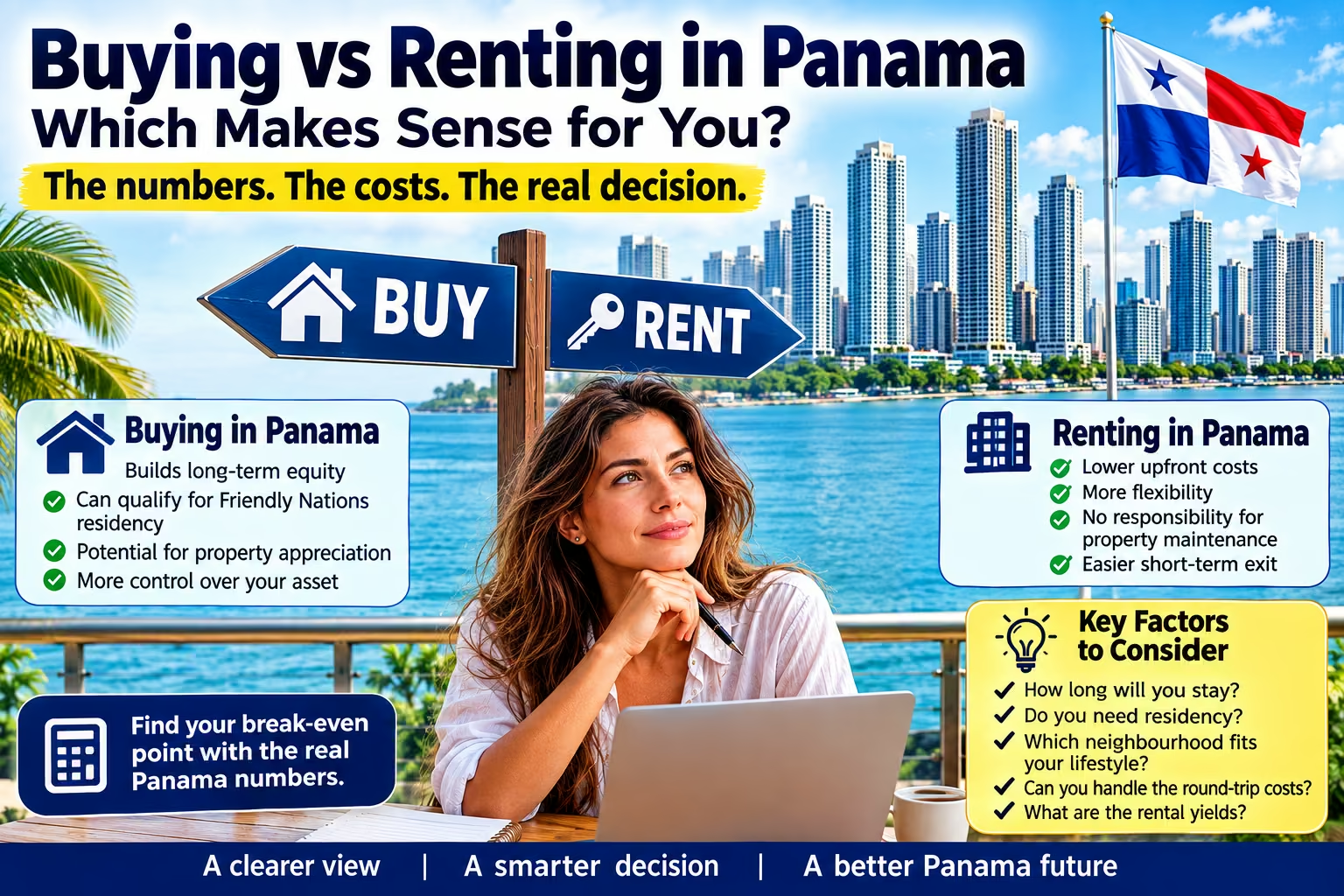
Buying vs Renting in Panama: Which Makes Sense for You
Under three years, rent. The transaction costs of buying and selling Panamanian property run to roughly 8 to 12% of the value round trip, and no plausible rental saving amortises that over a short stay.
Beyond three years it stops being a general question and becomes an arithmetic one, because two Panama-specific facts decide it. Realistic net rental yields sit near 4%, not the 7 to 9% quoted in sales offices. And for some readers the purchase is not a housing decision at all: a $200,000 property is one qualifying route to Friendly Nations residency, which changes the calculation completely and adds a lock-in that renting never carries.
This page gives you the break-even formula, the numbers to put in it, and the two variables every competing calculator omits. It is not investment or legal advice. Before committing money, use a Panamanian attorney who is not the seller’s and not the developer’s.
Four terms first:
- ITBI is the Impuesto de Transferencia de Bienes Inmuebles, Panama’s 2% real estate transfer tax.
- Cadastral value is the government’s assessed value of a property, which is often different from what it sells for.
- PH fees are homeowners’ association dues, from Propiedad Horizontal, Panama’s condominium regime.
- Gross yield is annual rent divided by price. Net yield is what remains after PH fees, insurance, taxes, vacancy, and management. The gap between them is where most buyers’ expectations break.
Key takeaways
- Round-trip costs are 8 to 12%, not the 2 to 4% quoted for entry. The difference is seller-side cost you pay on exit.
- Break-even in a flat market is roughly 1.5 to 3.5 years on friction alone, before any opportunity cost on your capital.
- Once opportunity cost is included, ownership at a 4% net yield has little cash-flow advantage over renting and investing the capital. The case then rests on appreciation.
- 2026 price outlooks run from about -5% to +4%, with older condo stock at the weaker end. That is a range with a real downside, not a forecast.
- Buying for residency creates a lock-in. The qualifying property must be maintained through the provisional residency period, and selling early can cancel your status.
- On exit, you pay 2% ITBI and a 3% income tax advance, both on the higher of the sale price or cadastral value.
- Many sellers overpay and never reclaim it. If 10% of your actual gain is less than the 3% advance, the excess is refundable.
- There is no MLS in Panama. You cannot easily verify you paid market price.
The six-question decision chain
Answer in order. An early answer often ends the analysis.
1. How long will you stay?
Under about three years, rent. Round-trip friction sets a floor that a short horizon cannot clear, and this single answer resolves most cases before any other variable matters.
2. Do you need residency through the property route?
If yes, the purchase does two jobs at once and the arithmetic changes.
3. Do you know which neighbourhood you want? If not, rent first. Panama City neighbourhoods differ sharply in liquidity and in how they hold value, and buying into the wrong one is expensive to undo.
4. Can you absorb the round-trip cost plus a possible decline? Roughly 10% of value in friction, plus a market range whose downside is negative. If that combination would hurt, rent.
5. Is your target segment liquid? Prime, well-priced stock and generic units in oversupplied towers are two different exit experiences in the same city.
6. Does the price-to-rent ratio favour buying at your price point? Compare the net yield you can realistically achieve against what the same capital earns elsewhere.
The break-even math
Here is the calculation nobody publishes, using only figures sourced below.
The formula. In a flat market, buying recovers its transaction friction when the annual benefit of owning matches what you spent getting in and out.
Transaction-friction recovery period ≈ round-trip transaction cost ÷ annual net ownership yield
This is a simplified friction-recovery calculation, not a complete rent-vs-buy break-even model. It estimates how long it would take the annual net benefit of owning to recover the transaction costs of buying and selling, assuming a flat property price and ignoring financing, opportunity cost, appreciation, depreciation and tax changes.
A true rent-vs-buy comparison needs those variables as well.
Worked at both ends of the published ranges:
| Round-trip cost | Net yield | Break-even |
|---|---|---|
| 8% (best case) | 6% (best case) | ~1.3 years |
| 10% (midpoint) | 4% (realistic) | ~2.5 years |
| 12% (worst case) | 3.5% (weak) | ~3.4 years |
So the honest answer to “how long do I need to stay” is roughly one and a half to three and a half years just to break even on friction, in a market that neither rises nor falls.
The Panama Rental Yield Reality (Gross vs. Net)
How standard recurring ownership deductions reduce a marketed 7.5% yield to true net return.
The part that changes the conclusion
That table ignores what your capital would have earned elsewhere, and once you include it, the picture shifts hard.
If you buy for cash at a 4% net yield, and the same capital could earn around 4% in liquid investments while you rent, then ownership’s cash-flow advantage is approximately zero. Break-even never arrives from rental savings, because there are none in net terms.
What that means: at Panama’s realistic yields, buying is a bet on appreciation, not a way of avoiding rent. And the 2026 outlook is a range of roughly -5% to +4%, with older condo stock weaker.
This is why “rent is dead money” is the wrong frame here. Rent buys flexibility and avoids a 10% round-trip toll. Whether that is a good trade depends on appreciation you cannot know in advance.
Why cost figures disagree: 2 to 4% or 8 to 12%?
Both figures circulate, and both are correct. They measure different things, and the reconciliation is the single most useful thing on this page for a buyer building a budget.
2 to 4% is entry only. That is what a buyer pays to acquire: legal fees, notary, registration, escrow. It is a real number, and it is not the hurdle.
8 to 12% is round trip. It adds what you pay when you exit, and in Panama the seller carries most of the transaction tax burden.
The exit side, itemised:
| Cost on exit | Rate | Base |
|---|---|---|
| ITBI transfer tax | 2% | Higher of sale price or cadastral value |
| Income tax advance | 3% | Higher of sale price or cadastral value |
| Agent commission | Typically the largest exit line | Sale price |
| Legal and notary | Variable | Transaction |
The two taxes alone are 5% of gross, and they are charged on the higher of price or cadastral value, which means a soft sale does not proportionally reduce them. Add commission and legal costs,s and the round-trip range makes sense.
One 2026 change worth knowing. Law 468 of April 2025 removed the ITBI exemption that applied to the first sale of newly built residential property. From 2026, new construction sales carry the full 2% transfer tax. If you are reading a cost guide written before that, its new-build figures are low.
Agent commission: The standard real estate commission in Panama is 5% (plus 7% ITBMS on the commission itself), and it is customarily paid by the seller.The new-build tax nuance: First transfers of newly constructed residential property operate under a sliding scale rather than the flat 2% transfer tax. Depending on the value band, first-time new builds are taxed at 0.5%, 1.5%, or 2.5%, whereas commercial new builds carry a steep 4.5% rate.
The Round-Trip Transaction Friction (8% to 12%)
Comparing entry costs paid at purchase vs. mandatory taxes and commissions paid at exit.
- Independent Attorney Due Diligence
- Public Registry Registration Fees
- Notary Fees & Escrow Admin
- Mortgage Origination (if financing)
- 2.0% ITBI Property Transfer Tax
- 3.0% Capital Gains Tax Advance
- 5.0% Realtor Commission (+7% ITBMS)
- Closing Legal & Document Minuta Prep
The residency interaction
For a meaningful share of readers, this is not a housing decision, and treating it as one produces the wrong answer.
Buying can do double duty. A property with a registered value of at least $200,000 is one of three qualifying routes to Friendly Nations residency. If you were going to obtain residency anyway, the purchase serves both purposes, and money you would have committed to another qualifying route is instead sitting in an asset.
But it creates a lock-in that renting never does. The qualifying tie must be maintained through the two-year provisional residency period. Selling the property before permanent residency is granted can result in cancellation of your immigration status, unless you acquire another qualifying property.
Three consequences follow, and no rent-versus-buy calculator prices any of them:
- Your exit window is not yours to choose for at least two years. A market you want to sell into, or a life change, meets an immigration constraint.
- A short-horizon buyer using this route is exposed twice, to the friction cost and to the lock.
- Qualification runs on the registered figure, not the price on your contract. A property bought at $240,000 and registered at $180,000 fails.
Our guides to the Friendly Nations Visa requirements and the Pensionado Visa cover the routes in full. The Pensionado is worth checking first if you have pension income, because it asks for no property at all.
Do not buy property principally for residency without taking advice on the maintenance obligation. It is the part that surprises people, and it surfaces at the worst moment.
Gross versus net yield
Every quoted yield you encounter in a sales context is gross. The gap to net is large and predictable.
Gross figures in circulation: around 7% as a general average, and 8 to 9% or more for small, well-run studio units.
Net figures once costs are deducted: roughly 3.5 to 6%, with realistic long-term net returns often described as around 4%.
What comes out in between:
- PH fees, the biggest line in most towers, and higher in buildings with extensive amenities.
- Vacancy, which is not zero in an oversupplied rental market.
- Management, if you are not here to do it yourself.
- Insurance and residual property tax. Primary residences are exempt on the first $120,000 of cadastral value under current rules, with 0.5% applying between $120,000 and $700,000, but an investment property is treated differently.
- Maintenance and turnover costs.
A 7% gross figure becoming a 4% net figure is not a bad building. It is the normal shape of the arithmetic, and a sales presentation that quotes gross without naming that gap is not lying so much as leaving out the half that matters.
Treat agency and developer market data as interested-party sourcing. Much of the published yield and price data for Panama comes from firms that earn commission on transactions. That does not make it wrong; it makes it a source with a position.
PH Fees: In Panama City, standard condominium fees run between $1.50 and $2.50 per square meter, per month. Luxury buildings with extensive amenities (pools, backup generators, concierges) often exceed $3.00 per square meter.
Property Tax: Panama heavily penalizes investment properties. If the property is registered as your Primary Residence (Patrimonio Familiar Tributario), the first $120,000 is tax-exempt, with the remainder taxed at 0.5% (up to $700k) and 0.7% (above $700k).
However, for investment or secondary properties, the exemption drops to just $30,000, and the tiered tax rates jump to 0.6%, 0.8%, and 1.0%. This higher tax burden directly eats into your net yield.
Liquidity is split by segment.
“I can always sell” assumes one market. There are at least two.
The liquid end. Correctly priced homes in established neighbourhoods including Costa del Este, El Cangrejo, San Francisco, Marbella and Bella Vista are reported to sell within roughly one to three months, with some sources citing 30 to 60 days.
The slower end. Generic condominium units in oversupplied towers are weaker, and older buildings could see price drops in the region of 10 to 15% if sellers become motivated.
Two implications for the decision:
Planning to sell is not an exit plan. Whether you can exit at an acceptable price depends on what you bought, not on your intention to sell it.
There is no MLS. Panama has no multiple listing service, so there is no straightforward way to verify that you paid market price or that a comparable sold for what an agent says. Pricing is opaque in both directions, which raises the value of independent representation and of taking time before committing.
How do you know you are not overpaying?
Panama has no multiple listing service. There is no shared database of what actually sold, for how much, or how long it sat. Agents work from their own inventory and their own knowledge, and two agents can describe the same market differently in good faith.
That has practical consequences a buyer from a transparent market does not expect.
Asking prices are weak evidence. A listing tells you what a seller hopes for, and in a market with slow turnover in some segments, a price can sit unchallenged for a long time without ever being tested.
Comparables are assertions. When you are told a similar unit sold for a given figure, that figure usually cannot be independently verified from a public source the way a sold price can elsewhere.
The registry tells you something, but not what you want. Recorded transaction values exist, but they are the values declared for tax purposes on the higher of price or cadastral value, and they are not a clean market comparable.
Three things partially close the gap. Use a buyer’s representative whose interest is not the sale of one specific unit. Ask directly how long the unit has been listed and whether the price has moved. And build in time, because opacity punishes speed more than it punishes caution.
Financing
A cash buyer and a financed buyer are answering different questions.
Local mortgage finance is available to foreigners in Panama, though terms differ from those offered to citizens and residents, and non-residents can expect stricter conditions and larger deposits.
Financing changes the arithmetic in two directions at once. It reduces the capital you tie up, which lessens the opportunity-cost problem in the break-even section. It also adds interest cost, which reduces net yield further.
Local mortgage financing is available to foreigners, but it is expensive. As of early 2026, non-resident foreign buyers typically face interest rates between 6.5% and 7.5%.
Banks enforce strict Loan-to-Value (LTV) maximums of 60% to 70%, meaning you must bring a 30% to 40% cash down payment to the table. Terms max out at 15 to 25 years. If you rely on Panamanian financing, the debt-service costs will almost completely erase your net yield.
Which variable binds, and how they compound
Every section above can be survivable alone and decisive together. That is the part a single-variable calculator cannot show you.
Take a four-year horizon, a unit in an older tower in an oversupplied segment, a buyer who needs financing, and no settled view on the neighbourhood. Each of those on its own has an answer:
- Four years clears the friction break-even in most scenarios. Survivable.
- An older oversupplied tower is the slower liquidity segment, and the one where a 10 to 15% decline is described as possible. Survivable if you are not forced to sell.
- Financing reduces the capital tied up but adds interest, lowering net yield. Survivable.
- Neighbourhood uncertainty normally argues for renting first. Survivable if everything else is strong.
Together they are not. The four-year horizon only clears break-even in a flat-to-rising market, and the segment chosen is the one most exposed to the downside. Financing cuts the yield that break-even depends on. And the neighbourhood uncertainty raises the chance of wanting to move, which forces a sale in the segment least able to absorb one.
This is why the order in the decision chain matters. Horizon comes first because it eliminates most cases outright. Segment and financing then act on the same variable, net yield, from opposite directions. Two moderate negatives on the same variable do more damage than one severe negative on a variable nothing else touches.
The practical test: identify which single variable your case is most sensitive to, then check whether anything else pushes on the same one. If two do, treat the break-even estimate as optimistic rather than central.
Exit mechanics, and the refund nobody claims
Two things about selling that most buyers never look at until they are selling.
What you pay. At closing, the seller remits 2% ITBI and a 3% advance income tax payment, both calculated on the higher of the gross sale price or the cadastral value.
The choice you have. The 3% advance may be treated as your final tax. Alternatively, you can compute the actual liability at 10% of the net gain, credit the 3% already paid, and claim a refund of the excess.
That second route matters more often than you would expect. If your actual gain is modest, or you sold at or near your purchase price, 10% of a small gain can easily be less than 3% of the whole sale price. The difference is refundable, and it is money many sellers leave behind because nobody chases it for them.
Run the arithmetic once, and it becomes obvious. On a $250,000 sale, the 3% advance is $7,500. If your actual net gain was $30,000, the 10% liability is $3,000, and roughly $4,500 is reclaimable. Ask your attorney or accountant explicitly whether they will file for it, because the default is that the advance stands.
One conflict worth knowing about
Published sources do not agree on Panamanian property capital gains. The strongest source, a major accountancy firm’s tax summary, states 10% on the net gain with the 3% advance creditable and the excess rebatable, and most 2026 sources agree.
But at least one 2026 source states the rate is 5%, and another claims the capital gains tax on real estate was abolished in favour of the transfer tax. Those are materially different claims about the same tax in the same year.
This page follows the accountancy firm and the majority. Confirm your own position with a Panamanian tax adviser before relying on any of it, including this page.
The definitive rule: Capital gains on Panamanian real estate are officially taxed at 10% on the net profit. However, to execute the sale, the government forces you to pay a flat 3% advance based on the gross transaction value (or cadastral value, whichever is higher).
If you see a ‘5% tax’ mentioned online, that refers to the withholding tax on securities and corporate shares, not real estate. The 2% transfer tax and the 3% capital gains advance are two separate taxes, and both must be paid at closing.
What to do next
If you are staying under three years, or you do not yet know the neighbourhood
If you are staying longer and buying for housing: run the break-even formula on your own numbers, using a net yield rather than a gross one, and include what the capital would earn elsewhere.
If you are buying principally for residency: get advice on the maintenance obligation first. The lock-in is the part that is not on any spreadsheet.
Rent vs. Buy Decision Diagnostic
Select your criteria below. If any red flag triggers, renting is the mathematically superior default.
Editorial Review & Verification
- Written by: Abakwa Studio Editorial Team
- Financial & Legal Review: Panamanian property taxation, non-resident mortgage LTV limits, and net-yield calculations.
- Last verified: August 30, 2026
- Review status: Tax thresholds verified against 2026 DGI (Dirección General de Ingresos) property tax brackets and capital gains regulations. Financing terms verified against standard non-resident lending guidelines from Panamanian banking institutions.
Primary Sources
- Dirección General de Ingresos (DGI) — Property Tax (Impuesto de Inmueble) and Capital Gains advance procedures.
- Registro Público de Panamá.
Editorial note: Panamanian real estate taxation depends heavily on proper Primary Residence registration and property value indexing. This analysis reflects the financial and legal frameworks verified as of August 30, 2026. This guide does not constitute legal or investment advice. Readers must consult a licensed Panamanian attorney and tax accountant before executing real estate transactions.

Abakwa Studio is the publishing team behind Lifestyle Panama, with a background in advertising technology. Our guides are drafted with AI assistance and then reviewed by our editor, Muhammad Shoaib, who has experience working as a visa agent in Pakistan. For visa, residency and tax topics, we check our guides against official Panamanian government sources. They are general information, not legal or tax advice.

