


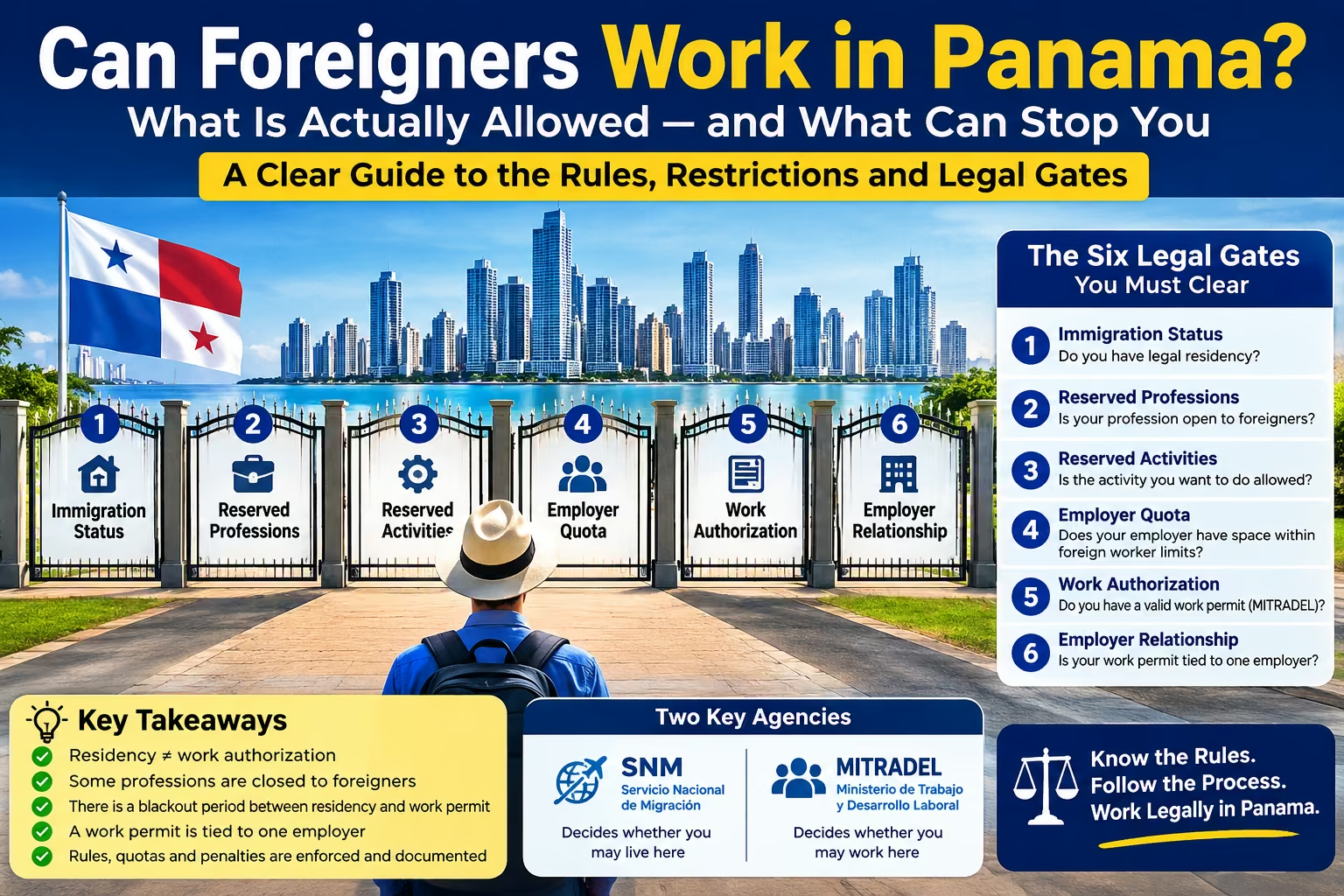
Can foreigners work in Panama? Yes, but the arrangement has to clear six separate gates, and each one can stop you on its own with everything else in order.
The two most expensive assumptions people arrive with are both wrong. A residency card is not a work permit, and there is a stretch of time where you are lawfully resident and still barred from working. And the list of professions closed to foreigners is much longer than the four that every guide repeats, which matters enormously if you are a nurse, a technician or an engineer planning a move around your career.
This page states each rule and names the provision behind it. It stops at the question “is this lawful.” The permit procedure itself is a separate guide. This is general information rather than legal advice, and the arrangements below turn on facts a Panamanian labour attorney should look at before you sign anything.
Four terms first, because they recur:
- MITRADEL is the Ministry of Labour, the Ministerio de Trabajo y Desarrollo Laboral. It decides work authorization.
- SNM is the National Immigration Service, the Servicio Nacional de Migración. It decides immigration status. Different agency, different file.
- A permiso de trabajo is the work permit MITRADEL issues. It is a separate document from your residency card.
- Idoneidad is the professional licence a technical board issues to practise a regulated profession. Some boards will not issue one to a foreigner at all.
Key takeaways
- Residency and work authorization are two files at two agencies. Holding one does not grant the other.
- There is a blackout period. The work permit application can generally only be filed once residency is granted, so there is a window where you are legally resident and legally barred from working.
- Constitutional Article 20 names no professions. It authorizes the law to restrict activities for foreigners. The actual closures sit in separate professional statutes, and there are many more than four.
- A work permit cannot open a reserved profession. If the profession is closed, the permit was never the binding constraint.
- Retail commerce is barred to foreigners as an activity, which means restructuring who employs you does not fix it.
- The quota is Labour Code Article 17, and its actual text is 90% of ordinary workers, plus foreign specialists capped at 15% of total workers. Two different denominators.
- Foreigners with a Panamanian spouse, or ten years of residence, count toward the Panamanian side of the quota.
- Permits are tied to one employer. Losing the job withdraws the authorization.
- Enforcement is documented and dated, and the worker-side consequences are heavier than the employer’s fine.
The 6-Gate Panama Work Authorization Gauntlet
Sequential checkpoints required before lawful employment can begin. Failing any gate halts authorization.
Two files, two agencies, and the blackout
Most countries bundle residence and work authorization into one document. Panama does not, and almost every avoidable problem on this page starts there.
SNM decides whether you may live here. MITRADEL decides whether you may work here. They are separate applications, separate criteria, and separate decisions. A permanent residency card issued by SNM says nothing about your right to take a job.
So a Friendly Nations permanent resident who signs an employment contract and starts on Monday is working unlawfully, with a valid residency card in their wallet and entirely regular immigration status. The card was never the authorization.
The blackout period
This is the detail that costs people the most, and it follows from the sequencing.
For most categories, the work permit application can only be filed once residency has been granted. Not once it has been applied for. That creates a window in which you hold lawful residence, have a job offer in hand, and are still barred from working while MITRADEL processes a file that could not have been opened any earlier.
Plan for that window financially. People who move on the assumption that residency approval is the finish line discover a further period of no lawful income at the point they have already committed to the move.
A signed offer does not shorten it. An offer is not authorization, and no amount of employer urgency changes the sequence.
Under the current immigration framework, you do not have to wait for your final permanent residency approval to file for a work permit. Once the National Immigration Service (SNM) accepts your initial residency application and issues your temporary processing card (carné de trámite), your employer can file the work permit application with MITRADEL.
However, the blackout period still applies: MITRADEL processing times currently range from 2 to 6 months in Panama City (and up to 9 months in outer provinces like Chiriquí). During those months, you hold legal temporary residence but remain legally barred from working until the permit is actually in hand.”
The Statutory Blackout Timeline (SNM vs. MITRADEL)
Visualizing the lawful residency period where employment remains prohibited by law.
Article 20 and how restriction actually works
Every restriction below traces to one constitutional provision, and reading it properly dismantles the most repeated claim on this topic.
Article 20 of Panama’s Constitution opens by putting Panamanians and foreigners on an equal footing before the law. That is the half our property guide relies on. The half that governs work is the qualification that follows it, which in the official English translation reads:
“…but the Law, for reasons of labor, health, morality, public security and national economy, may subject to special conditions, or may deny the exercise of specific activities to aliens in general.”
Read what it does and does not do. Equality is the baseline. The qualification then reserves to the legislature a power to impose special conditions on foreigners, or to close specific activities to them, on five named grounds. One of those grounds is labour.
It names no professions. It is an enabling provision, not a list.
That single fact is why “only four professions are constitutionally reserved” is wrong. Nothing is reserved by name in the Constitution at all. Closures live in individual professional statutes, each passed for its own profession, and the set of them is considerably larger than four.
This is the same Article 20 that underpins equal treatment for foreign property buyers, where its first half does the work. Here the second half does.
Reserved professions, done properly
Search this topic, and you will be told, repeatedly and confidently, that four professions are closed to foreigners: law, engineering, accounting and psychology. Treat that as a starting point rather than the answer.
What is actually true. The Constitution authorizes restriction. Separate statutes then reserve individual professions, each with its own governing law and its own licensing board. The count is higher than four, and the reserved set includes healthcare occupations and several skilled trades alongside the professions usually listed.
If you are a nurse, a medical technologist, a physiotherapist, an electrician or a similar licensed practitioner, do not rely on any published list, including a summary in an article like this one. Check your specific profession against its own statute and its own board before you commit to a move. That is a question for a Panamanian labour attorney, and it is worth the fee.
Why a work permit cannot rescue this
The gates are sequential, and this one sits above the permit.
A foreign national cannot practise a reserved occupation regardless of whether they hold a work permit. Permit approval, an apostilled degree, an employer with quota headroom- none of it reaches a closure that operates on the profession itself. If your field is reserved, MITRADEL was never the binding constraint, and the paperwork you are assembling addresses a gate you had already passed.
The practical test to run early: is my profession reserved, and will its board grant idoneidad to a foreigner? Ask that before you ask anything about permits. It is the cheapest question to answer and the most expensive to get wrong.
| Regulated Profession | Governing Statute |
|---|---|
| Nursing | Law 1 of 1954 |
| Dentistry & Dental Assisting | Law 22 of 1956 / Law 21 of 1994 |
| Architecture & Civil Engineering | Law 15 of 1959 |
| Agricultural Sciences & Agronomy | Law 22 of 1961 |
| Pharmacy & Medical Visiting | Law 24 of 1963 |
| General Medicine | Executive Decree 196 of 1970 |
| Psychology | Law 56 of 1975 |
| Accounting | Law 57 of 1978 |
| Law (Attorneys) | Law 9 of 1984 |
| Veterinary Medicine | Law 3 of 1983 |
| Social Work & Sociology | Law 17 of 1981 / Law 1 of 1996 |
| Security Officers | Law 56 of 2011 |
Note: This is an illustrative, not exhaustive, list. It highlights that closures extend deeply into healthcare, construction, and specialized trades. Always consult the governing board (Junta Técnica) for your specific field before relocating.
Retail commerce, ownership and labour
A second closure operates on activity rather than profession, and it produces the most misunderstood advice in this area.
Retail commerce is reserved to Panamanians. The restriction attaches to the activity itself.
That distinction is the whole point. Because it binds the activity, changing who employs you cannot cure it.
The advice that does not work
People are routinely told: form your own corporation, employ yourself, problem solved. It does not work, and the reason is worth understanding because it generalises.
Foreigners can own Panamanian companies, invest in them and supervise them. MITRADEL’s position is that a foreigner cannot manage the business in the operational sense. Ownership and labour are separate questions. Owning the entity that conducts a reserved activity does not permit you to personally perform it.
Restructuring the employer cannot fix a restriction on the activity. If retail commerce is closed to foreigners, it is closed whether the shop belongs to a Panamanian employer, to a company you own, or to you personally. You have changed the employment relationship and left the binding constraint untouched.
What a foreign owner can generally do: hold the shares, take profits, appoint management, sit on the board, direct strategy. What sits in contested territory: serving customers, running daily operations, performing the reserved activity personally. That line is fact-specific, and it is exactly the kind of question to put to counsel before opening.
The employer quota
Even with residency, an open profession and a permitted activity, your employer needs room for you.
The provision is Article 17 of the Labour Code, and its actual text matters because summaries of it circulate in several incompatible forms. What the Code says is that every employer shall maintain Panamanian workers, or foreigners with a Panamanian spouse or ten years of residence in the country, in a proportion of not less than 90% of ordinary workers, and may maintain specialized or technical foreign staff not exceeding 15% of total workers.
Three things follow that summaries usually lose.
The two percentages have different denominators. The 90% floor is measured against ordinary workers. The 15% ceiling for specialists is measured against total workers. Anyone quoting a single blended figure has flattened two separate tests.
Long-settled foreigners count on the Panamanian side. A foreign national married to a Panamanian, or with ten years of residence, counts toward the 90%. That means a long-term resident is not consuming quota, which is a materially different position from a new arrival and is rarely mentioned.
The quota applies to payroll, not only headcount. The Code adds that the proportions of wages and allowances, in aggregate and by category, may not fall below the same figures. An employer cannot satisfy the rule by counting heads while concentrating the payroll on foreign staff.
Article 17 also allows a larger proportion of foreign specialists or technicians for a defined period, on the recommendation of the relevant ministry and with the Labour Ministry’s approval. Related provisions empower the executive to raise the Panamanian proportion according to economic conditions, and impose an obligation on employers authorized to hire foreign specialists to replace them with Panamanians within a maximum of five years.
That five-year replacement duty is worth knowing before you accept a specialist role. The permission you are hired under contemplates your eventual substitution.
Article 17 Labour Quota Mechanics
How Panama calculates statutory workforce proportions across ordinary and specialized roles.
The 90% floor applies to ordinary workers; the 15% cap measures technical staff against all workers.
The percentage applies to total wages and salaries, not just raw number of employees.
Companies hiring foreign specialists must train Panamanian replacements within 5 years.
Quota-exempt regimes
Several special regimes sit outside the ordinary quota, and they change the answer completely for employers inside them. Multinational headquarters regimes, certain special economic zones and similar arrangements operate under their own rules.
If your prospective employer is inside one, the quota conversation is different. If they are not, and they are at their limit, your application is refused for reasons that have nothing to do with you.
Executive Decree 4 of March 2023 fundamentally reorganized Panama’s work permit categories, unifying them into broader groups. However, it did not eliminate the ordinary 10% standard and 15% technical/trusted quotas for standard domestic corporations.
Companies operating within specific Special Economic Zones—such as the Multinational Headquarters (SEM) regime, the EMMA regime (manufacturing), Panama Pacifico, and the City of Knowledge (Ciudad del Saber)—continue to benefit from separate, highly relaxed labor quotas under their own governing statutes.
If your prospective employer operates under one of these specific economic frameworks, the standard Article 17 quota caps do not apply in the same way.
Foreign-source income as the dividing line
The single most useful question for deciding whether any of the above applies to you: whose market is paying you?
Foreign-source income, foreign clients, foreign employer. Your income comes from outside Panama, and you are not selling into the Panamanian market. Your immigration status governs, and you are largely outside MITRADEL’s permit regime. This is the position most remote workers on a short-stay remote worker permit are in, and it is why that route exists.
Panamanian-market income. A Panamanian employer, Panamanian clients, or selling to people here. Every gate on this page applies.
Two misreadings of this are common, and both are expensive.
“It’s remote, so the rules don’t apply.” Location of the desk is not the test. Working from an apartment in Panama City for a Panamanian company, on a tourist stamp, is local work. The client’s market decides, not where the laptop sits.
“The digital nomad visa lets me work here.” It does not, generally. Panama’s short-stay remote worker permit is built around foreign-source income and excludes work for the Panamanian market. It is not a workaround for taking a local job.
Permits are tied to the employer.
A standard work permit authorizes you to work for a specific employer, not to work in Panama generally.
Two consequences.
Losing the job withdraws the authorization. Redundancy at month eight does not leave you with eight months of permit to job-hunt on. The authorization was tied to a relationship that has ended.
Changing jobs requires a new permit, not a transfer, and the new employer must have quota headroom of their own.
This changes how you should think about a Panamanian job offer. A permit is not a portable credential you acquire once. It is a link between one worker and one employer, and it is only as durable as that employment.
Enforcement and penalties
This is checked, and the record is specific rather than theoretical.
A joint MITRADEL and immigration operation across bars, restaurants and businesses in the capital in April 2025 found 22 foreigners working without permits and 12 without valid immigration status. A further operation in March 2026, across Panamá, Bocas del Toro, Coclé and Panamá Oeste, found 10 more, including three working in shops on Isla Colón.
Those are ordinary hospitality and retail businesses, not edge cases.
The employer penalty ladder
| Violation | Penalty |
|---|---|
| First | $500 per unpermitted worker, with no stated maximum |
| Second | $1,000 per unpermitted worker |
| Third | $10,000 flat, plus suspension of the operating permit |
| Fourth | Operating permit cancelled, immediate termination of all unauthorized foreign staff, and publication of the company’s name by the Ministry of Labor.r |
The worker’s exposure is the larger one
The instinct is to treat this as the employer’s problem, since the fines land on the company. That reads the risk backwards.
The employer faces a fine. The worker faces deportation, a re-entry ban, and damage to any future residency or citizenship application in Panama. A company absorbs a $500 penalty as a cost. A person who has moved their life here does not absorb a re-entry ban.
If an employer tells you to start while the permit is pending, understand that the two of you are not carrying comparable risk.
Four rules, one outcome
The gates are independent, which means several can be closed at once and each closure produces the same sentence: you cannot take this job.
Consider a ten-person firm that wants to hire a foreign accountant into a client-facing retail role. Four gates are shut simultaneously. Accounting is a reserved profession. Retail commerce is a reserved activity. The candidate has no residency, so no permit can be filed. The firm is at its Article 17 limit.
Four different rules, four different fixes, and clearing any one of them leaves the arrangement unlawful. Getting residency does not open the profession. Opening quota headroom does not change the activity. This is why “we sorted the paperwork, and it still did not work” is such a common experience: the paperwork addressed one gate while three others stayed shut.
Two practical consequences follow.
Check all six before fixing any one. Each gate is cheap to check and expensive to discover late. A reserved profession takes one conversation to establish and can end the question before anyone spends money on apostilles.
Know which authority owns which gate, because you cannot ask the wrong one. Reserved professions belong to the individual licensing board, not to MITRADEL. Residency belongs to SNM. Quota and permit issuance belong to MITRADEL. Reserved activities are a matter of statute rather than any single agency’s discretion. Asking MITRADEL whether your profession is open gets you an answer about permits, which is a different question.
Where the sources disagree
Three conflicts run through the published material on this topic. Two remain open,n and one is now resolvable.
The quota provision and its numbers: resolvable. Most sources cite Labour Code Article 17 at 10% and 15%. At least one firm publishes an Article 27 requiring an 80% Panamanian workforce for companies with ten or more employees.
The Labour Code text at Article 17 reads 90% of ordinary workers and 15% of total workers for foreign specialists, which is neither of the summaries in the form they are usually given. Work from the Article 17 text, and ask counsel to confirm whether any separate provision imposes a further threshold at ten employees.
Processing time: open. Published estimates run from one to three months, and from two to six months or longer. Nobody appears to publish an official service standard. Treat any specific figure as an estimate rather than a commitment, and plan the blackout period against the longer end.
The third-violation fine: open. Sources give both a flat $10,000 with suspension of the operating permit, and a figure of up to $15,000.The latter uses the more commonly published version, and the discrepancy is unresolved.
Processing time: resolved. MITRADEL processing timelines are highly localized. As of late 2025/2026, standard processing in Panama City takes between 2 and 6 months. Regional offices, particularly in David (Chiriquí), have been documented taking up to 9 or 10 months. Plan your financial blackout period around these longer horizons.”
“The third-violation fine: resolved. The penalty structure is standardized. A third offense triggers a flat $10,000 fine. More importantly, it empowers the Ministry to suspend the business’s Aviso de Operación (operating permit), effectively shutting down the company’s ability to trade.
Can foreigners work in Panama? What to do next
Work the gates in order, because each one above makes the ones below it irrelevant.
- Is your income foreign-source or from the Panamanian market? Foreign-source, and most of this page does not apply to you.
- Is your profession reserved? Check the statute, not a list. If it is closed, stop here.
- Is the activity retail commerce? If so, no ownership structure fixes it.
- Do you have residency? No permit is possible without it.
- Does the employer have quota headroom or an exemption?
- Has MITRADEL actually issued the permit? Until then, working is unlawful.
If a gate blocks you, the useful question is whether it is fixable. Quota and residency are timing problems. A reserved profession and a reserved activity are not.
Editorial Review & Verification
- Written by: Abakwa Studio Editorial Team
- Legal & Data Review: Constitutional employment limitations, MITRADEL quota enforcement, and professional licensing restrictions.
- Last verified: August 25, 2026
- Review status: Verified against the Constitution of the Republic of Panama (Article 20), the Panamanian Labour Code (Article 17), and Executive Decree 4 of March 2023.
Primary Sources & Registries
- Constitution of the Republic of Panama
- Ministry of Labour and Workforce Development (MITRADEL) — Executive Decree 4 of March 2023
- National Immigration Service (SNM)
- Panamanian Labour Code (Código de Trabajo)
Editorial note: Panamanian labour and immigration laws are governed by separate ministries and are subject to frequent executive adjustment. This analysis reflects the official frameworks verified as of August 25, 2026. This guide does not constitute legal or immigration advice. Readers must consult a licensed Panamanian labour attorney before accepting employment or relocating.

Abakwa Studio is the publishing team behind Lifestyle Panama, with a background in advertising technology. Our guides are drafted with AI assistance and then reviewed by our editor, Muhammad Shoaib, who has experience working as a visa agent in Pakistan. For visa, residency and tax topics, we check our guides against official Panamanian government sources. They are general information, not legal or tax advice.

