


Panama Digital Nomad Visa Income Requirement: Does Your Income Actually Qualify?
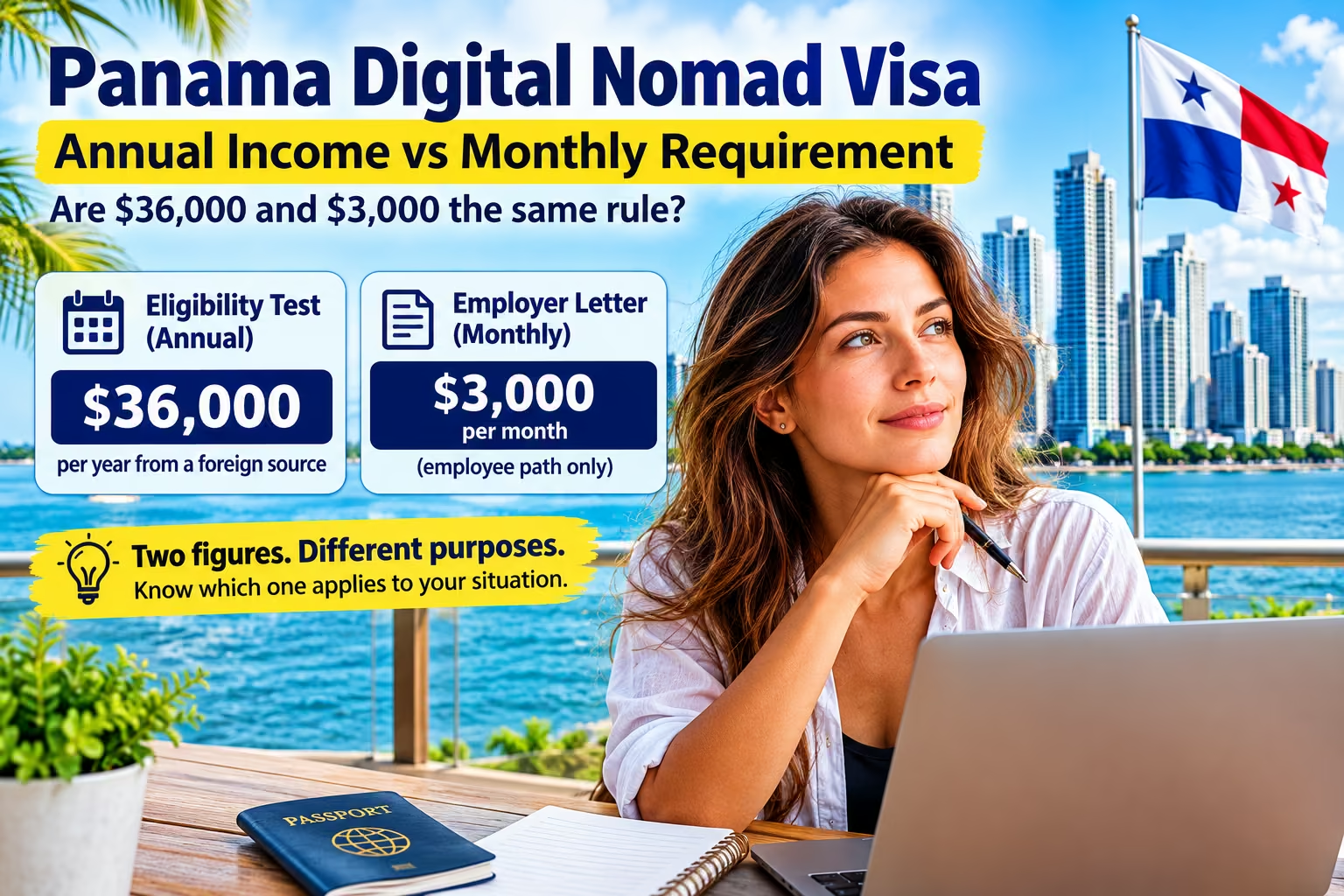
Both figures you have seen are real. $36,000 a year and $3,000 a month both appear in Panama’s published requirements for this visa, and almost every guide treats the Panama digital nomad visa income requirement as one rule stated two ways.
They are not. Each sits in a different part of the requirements and does a different job, and for anyone whose income arrives unevenly, that difference decides the application.
Here is the short version. The eligibility test is annual: the rules describe income from a foreign source with an annual amount of not less than $36,000, or the equivalent in another currency. The monthly figure appears in the employer letter requirement, which specifies that the letter must state monthly income of not less than $3,000. One is the threshold. The other is a specification for a document that only the employee path files.
This page is for people running the numbers before gathering anything: freelancers with uneven months, people whose income is partly passive, non-dollar earners, and couples. If you already know you qualify, skip to applying for the remote worker visa, which covers documents and filing. Nothing here is legal advice; it is background for a conversation with someone qualified.
Key takeaways
- The eligibility threshold is stated annually: $36,000 from a foreign source, or currency equivalent.
- The $3,000 monthly figure is a document specification, attached to the employer letter, not to the eligibility test.
- The self-employed path does not file that letter at all. The rules let a self-employed applicant swap out the employer-letter requirement entirely.
- Income has to attach to remote work. The rules tie it to a contract with a foreign company or to self-employed telework, which is why a large portfolio is not obviously a substitute.
- Savings cannot satisfy it. The requirement is a flow of income, not a balance.
- Foreign source is about the payer, not your desk. A Panamanian subsidiary of a foreign firm is a real complication.
- Other currencies are accepted at the equivalent amount.
- The $4,000 family threshold is unverified. It appears in some published guides and not in the immigration service’s own requirements sheet, which describes the applicant alone.
Annual or monthly?
This is the question the page exists to answer, and the answer is more useful than either side of the usual argument.
Where each figure sits. The immigration service’s published requirements for this permit open with the eligibility conditions. Among them: the applicant receives income from a foreign source in an annual amount of not less than $36,000, or its equivalent in another currency. That is the qualification test, and it is expressed as a yearly total.
Separately, further down the same requirements, sits the list of documents. One of them is a letter from the employing company. That letter is required to state the applicant’s monthly income, not less than $3,000 or the foreign-currency equivalent, together with how often payments are made and confirmation that the money comes from abroad.
So the monthly number is real, and it is a requirement. It is a requirement about what a document must say, on the path where that document exists.
Why that distinction has teeth. The rules provide two applicant profiles: someone contracted to a foreign company, and someone self-employed working remotely. The self-employed applicant is expressly excused from the employer-letter requirement and files a notarised statement about their clients instead. That statement has to describe what they earn and how often they are paid. It does not carry a stated monthly minimum.
What this means for uneven income. A freelancer earning nothing in two months and $9,000 in the third reaches $36,000 across the year. On the annual eligibility wording, they meet the threshold. They are not filing an employer letter, so the $3,000 monthly specification is not a document they have to satisfy.
That is a reading of the published requirements, not a guarantee of how an officer assesses a particular file. Which is exactly why it is worth putting to an attorney before you spend anything.
In practice, the National Immigration Service (SNM) evaluates freelancers on the annual total. Officers review the provided bank statements to ensure the total deposits linked to remote work equate to at least $36,000 annually.
Because freelancers file a sworn declaration of clients instead of a corporate employer letter, a strict $3,000 monthly floor is not rigidly applied to each individual month, provided the aggregate income threshold and active work status are proven.
What counts as income
The threshold is not a wealth test, and this catches people who are comfortably solvent.
The rules tie income to work. Eligibility is framed around two situations: holding a contract with a foreign company of a transnational character, or being a self-employed worker in telework mode, in both cases performing functions whose effects occur abroad. Income is described as flowing from that arrangement.
Savings do not substitute. Showing $300,000 in an account does not answer a requirement expressed as income received. A balance is a stock; the requirement is a flow. However large the balance, it is not the thing being asked for.
Passive income is the genuinely uncertain case. Dividends from a foreign portfolio, rental income from a property abroad, or a private pension are money from a foreign source, and they are not obviously income from a remote-work relationship. The published requirements do not address them directly. They frame income around the work arrangement, which means someone living on investment returns with no remote work is not the applicant these rules describe.
Do not read that as a refusal. Read it as: the rules do not provide for it, so nobody should tell you it qualifies without checking.
| Income type | Fits the framing? | Note |
|---|---|---|
| Salary from a foreign employer | Yes | The clean case |
| Foreign freelance or contract income | Yes | Self-employed path |
| Dividends or portfolio income | Not addressed | No work relationship |
| Rental income from abroad | Not addressed | Same issue |
| Private pension | Not addressed | The Pensionado route is built for pension income |
| Savings or a lump sum | No | Not income |
| Work for Panamanian clients | No | Not foreign source |
If your income is a pension, the Pensionado Visa exists precisely for that and asks far less.
Executive Decree 198 is explicitly a Worker visa. SNM categorically rejects passive income (dividends, rental yields, or pensions) for this route. The regulations mandate that your bank statements show funds that are strictly ‘linked to the declared work’ (vinculados al trabajo declarado). If you submit a mixed file, officers will exclude the passive income from your total; if your active remote-work income alone falls below the $36,000 threshold, the application will be denied.
What “foreign source” actually means
Three tests appear in the rules, and they are about the payer and the work rather than about where you are sitting.
The payer is registered and operating outside Panama. A company incorporated and trading elsewhere. This is the primary test.
The work is done for a foreign company or as foreign-facing self-employment. The rules describe a contract with a foreign company of transnational character, or self-employed telework.
The effects of the work occur abroad. Your output serves a market outside Panama.
The edge cases
A Panamanian subsidiary of a foreign firm +
A foreign client who resells into Panama +
Mixed client bases (Local & Foreign) +
Crypto payments +
Currency, gross versus net, and the lookback
Currency. The rules state the threshold as $36,0,00 or the equivalent in another currency, so earning in euros, pounds, or yen is not a barrier. Expect a conversion showing the dollar equivalent, produced by a competent entity rather than by you.
Exchange rates move. Someone converting at close to the line should build a margin rather than clearing $36,000 by a few hundred dollars on a favourable rate.
Gross or net. The published requirements do not specify. That silence matters most for contractors, whose gross and net can differ by a third once tax and costs come out. Anyone within reach of the line should treat this as an open question rather than assuming the favourable reading.
Because SNM assesses income by looking at the actual deposits landing in your provided bank statements, they effectively measure net received income. If you invoice $37,000 a year gross but only $34,000 lands in your account after platform fees or taxes, you will fail the financial test. Your bank deposits must demonstrably cross the $36,000 line.
The lookback. How much history you need is not settled in the published material either. Guides variously describe two months of bank statements, and three to six. The requirements themselves ask for a bank certification or stamped statements demonstrating that income arrives from abroad and connects to your declared work, without naming a period.
One published claim goes considerably further: that the immigration service assesses average annual income across the three years before filing. If that were the rule, anyone who recently increased their income would be excluded. It appears in one source and nowhere else, and it is not in the published requirements. Treat it as unverified.
Dependents: genuinely unresolved
Several guides state that including a spouse and children raises the threshold to $4,000 a month.
The immigration service’s own published requirements sheet for this permit describes the applicant alone. There is no spouse provision, no dependent document list, and no higher income figure anywhere in it.
Two possibilities, and the honest position is that we cannot tell which from published sources. Either the firms quoting $4,000 know something operational that the sheet does not capture, or the figure has been imported from a different visa category and repeated.
What to do with that:
- Do not build a family application around $4,000 on the strength of a blog, including this one.
- Ask any firm that offers family inclusion to cite the provision that authorises it, and to do so in writing before you pay anything.
- Get the answer before you commit, because if there is no dependent provision at all, the plan is not “a higher threshold” but “a different route for your spouse.”
The dependent question is resolved, and the answer is no. Unlike most Panamanian residency categories, Executive Decree 198 does not allow the primary applicant to attach dependents (spouses or children). Every member of a family must qualify for their own immigration status independently.
The $4,000 family threshold you see circulating on blogs is a mistake: it has been accidentally copy-pasted from Costa Rica’s digital nomad visa requirements (which requires $3,000 for individuals and $4,000 for families). Do not base your family’s relocation on this error.
When several questions apply at once
Most readers do not have one complication. They have three, and the answers point in different directions.
Take a freelancer with uneven months, paid partly in cryptocurrency, whose client list includes the Panamanian subsidiary of a US firm, applying alongside a spouse. That is four separate questions with four separate answers:
- The uneven months turn on the annual reading, and on the fact that the self-employed path files no employer letter.
- The crypto portion is an evidence problem rather than a threshold one. It has to be shown arriving from abroad and tied to declared work.
- The Panamanian subsidiary is not foreign-source income, so that client’s revenue probably should not be counted toward the total at all.
- The spouse runs into the unresolved dependent question, which may not have an answer in the published rules.
Notice what happens if you only fix one. Removing the subsidiary’s revenue from your total might drop you below $36,000, which changes the answer to question one. Resolving the dependent question does nothing for any of the others.
Work out your qualifying total first, counting only income that is clearly foreign-source and clearly attached to remote work. That figure, not your gross earnings, is the one to test against the threshold. Everything else follows from it.
Claims to treat as unverified
Three circulate widely enough to plan around, and none is supported by the published requirements.
| Claim | Status | What to do |
|---|---|---|
| $4,000 a month for families | Not in the requirements sheet | Ask for the provision in writing |
| Three-year average income assessment | Single source, unsupported | Ignore unless an attorney confirms |
| A fixed number of months of statements | Varies by source; unspecified in the rules | Ask what your attorney’s files actually use |
How to check rather than trust a page
Ask which document the figure comes from. A firm quoting a threshold should be able to name the decree or the requirements sheet and the article. “It’s $4,000 for families” without a source is not an answer.
Check whether a source distinguishes the annual and monthly figures. A guide presenting them as interchangeable has not read the requirements closely, which tells you how much weight to give the rest of it.
Prefer the immigration service’s own published sheet over any summary of it, including this page.
What to do next
Work through it in this order, because each answer makes the next question worth asking.
- Is your income from remote work rather than from assets? If it is entirely passive, this is likely the wrong route, and the Pensionado may be the right one if it is pension income.
- Is the payer registered and operating outside Panama? Check the entity on your contract, not its parent.
- Does the annual total reach $36,000 equivalent? Use the yearly figure, and build margin if you are converting currency.
- Are you on the employee or self-employed path? It determines whether the monthly document specification applies to you.
- Do you need to include family? If so, resolve the dependent question before anything else.
Once you have answered those, the next step is documents, and that is a separate exercise with its own traps.
Editorial Review & Verification
- Written by: Abakwa Studio Editorial Team
- Legal & Data Review: Remote work visa eligibility, dependent restrictions, and financial evidentiary standards.
- Last verified: August 29, 2026
- Review status: Verified against Executive Decree 198 of May 7, 2021 (Decreto Ejecutivo 198) and current National Immigration Service (SNM) practices. Note that SNM strictly enforces the exclusion of dependents and passive income for this specific visa subclass.
Primary Sources
- Ministerio de Seguridad Pública / Servicio Nacional de Migración (SNM)
- Decreto Ejecutivo No. 198 del 7 de mayo de 2021
Editorial note: Panamanian immigration policies are subject to executive adjustment. This analysis reflects the official frameworks verified as of August 29, 2026. This guide does not constitute legal or immigration advice. Readers must consult a licensed Panamanian attorney to evaluate their specific financial documentation before applying.

Abakwa Studio is the publishing team behind Lifestyle Panama, with a background in advertising technology. Our guides are drafted with AI assistance and then reviewed by our editor, Muhammad Shoaib, who has experience working as a visa agent in Pakistan. For visa, residency and tax topics, we check our guides against official Panamanian government sources. They are general information, not legal or tax advice.

