


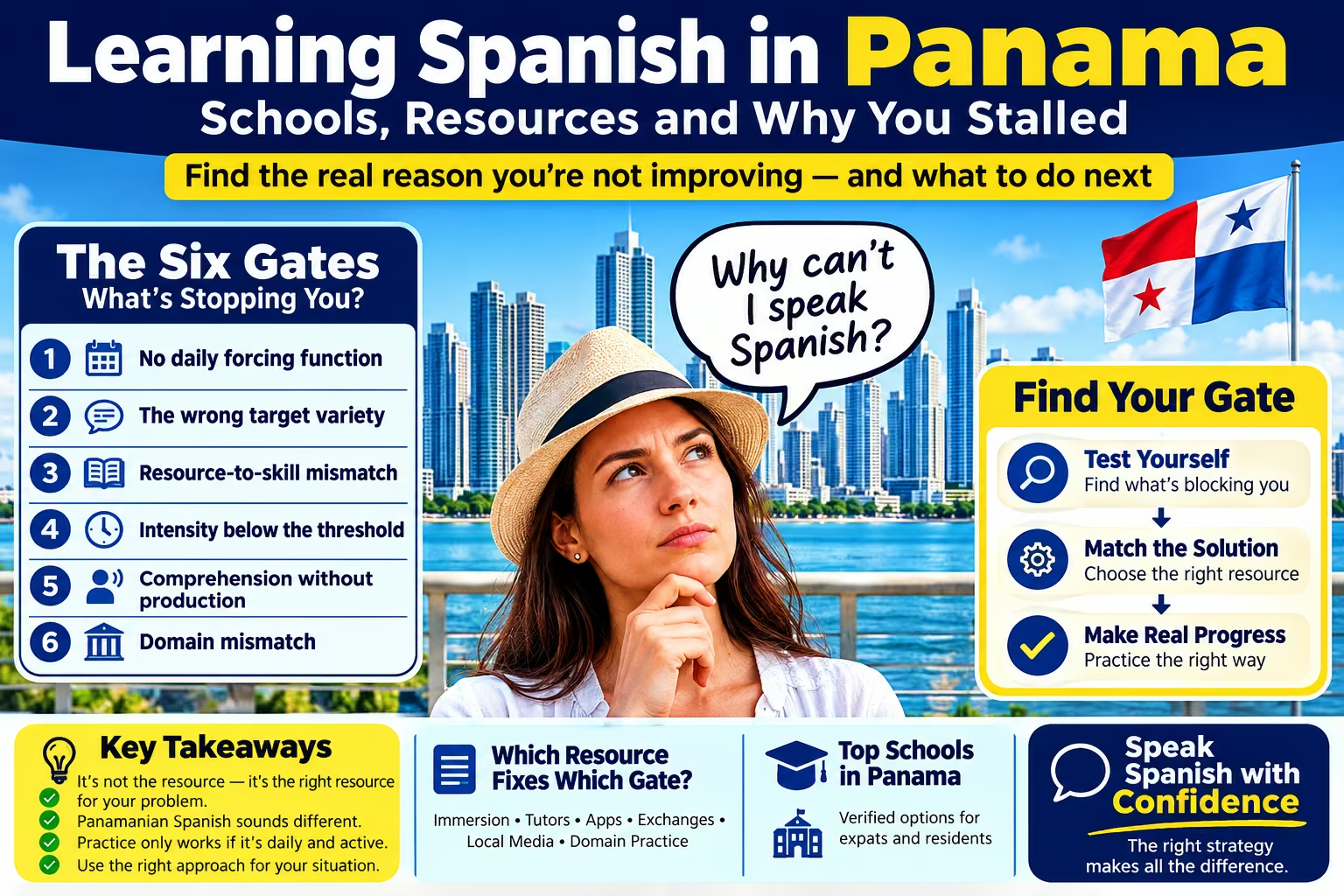
If you have been here a while and still order in English, the problem with learning Spanish in Panama is probably not the resource you chose. It is that you chose a resource aimed at a different problem than the one you have.
Six things independently stop people reaching conversational Spanish in Panama, and each one on its own is enough. Motivation and money do not fix any of them if you are pointed at the wrong gate. A person whose listening fails against fast local speech will not be helped by more vocabulary, no matter how many months they spend on it.
This guide is written first for the stalled learner: six months to five years in, functional at the café, silent at the bank, and quietly embarrassed. If you are starting from zero, skip to the last section. If you are stalled, the diagnostic is the point.
Nobody paid for a mention on this page. We have no commercial relationship with any school named here.
Key takeaways
- The most common blocker is the absence of a daily forcing function. Without one, any resource decays between sessions, and this is why a weekly class can produce years of no progress.
- Panamanian Spanish is a different listening target from the neutral Latin American Spanish most courses teach. Comprehension failing here after succeeding elsewhere is not skill regression.
- Understanding is not speaking. Input-only study produces a permanent intermediate plateau where you follow everything and answer nothing.
- Locals switching to English is structural, not a verdict on your accent. It has to be managed deliberately because it removes the practice you came for.
- Intensity has a floor. Gains below roughly four to five hours a week tend to decay between sessions faster than they accumulate.
- Fluency is domain-specific. Being comfortable ordering food predicts almost nothing about handling a bank or a contractor. Politeness carries as much weight as vocabulary, and our guide to Panamanian cultural norms covers greetings and usted.
- Moving to a town with fewer expats does not fix a practice-structure problem. It changes the scenery around the same gap.
The six gates
Each of these blocks progress on its own, and they compound. Read them in order, because an earlier gate makes the later ones irrelevant.
1. No daily forcing function. Something that obliges you to use Spanish whether you feel like it or not. Most expats in Boquete, Coronado, and parts of Panama City live inside an English bubble by default: English-speaking friends, English-speaking service providers, English menus. Without a daily obligation, everything you learn on Tuesday has faded by the following Tuesday.
2. The wrong target variety. Most courses and apps teach a neutral Latin American Spanish. What is spoken on the street here has a different rhythm and different sounds. You can be genuinely competent in the taught variety and still fail to follow a conversation at a fonda.
3. Resource-to-skill mismatch. You are training a skill that is not the one failing. An app that drills written recognition does very little for real-time listening. Effort goes in, and the failing skill does not move.
4. Intensity below the threshold. Language gains decay. Below a certain weekly volume, you lose between sessions roughly what you gained during them. A single weekly class is the classic example: consistent, sustainable, and often net zero over a year.
5. Comprehension without production. You listen, read,d and study. You rarely speak under time pressure. This produces the most common plateau in Panama: people who understand a great deal and cannot construct an answer, because constructing an answer is a separate skill that only improves by doing it.
6. Domain mismatch. Vocabulary and confidence are domain-bound. You may be fine at the supermarket and helpless with a plumber describing a leak, or with a bank clerk explaining a form. This is not a general fluency problem, and general classes do not fix it.
They compound, which is why one fix changes nothing
Consider a Boquete resident with two hours of class a week, an app on the side, an English-speaking social circle, who needs Spanish to argue with a contractor. Four gates are open at once: no forcing function, intensity below threshold, no production practice, wrong domain.
Upgrading the class addresses one of the four. The complaint after three more months is identical: “I am not improving.” That is what makes this so demoralising. Every fix appears to fail, because each one leaves three gates open.
Why Panamanian Spanish sounds different
This is the gate people most often mistake for personal failure, and it is really a story about how Panama was settled.
Panamanian Spanish belongs to the Caribbean group, which traces back to settlement from southern Spain rather than the highland varieties that shaped Mexican or Colombian Andean speech. Two features do most of the damage to a learner’s comprehension.
Final and pre-consonant /s/ often softens to a breath or disappears. Las casas can arrive sounding closer to lah casah. Learners trained to expect a crisp s lose word endings, and word endings in Spanish carry plurals and verb persons.
The pace is quick, and words run together. Softening sounds is part of what allows the speed.
Both are ordinary features of a major world dialect. Neither is lazy, incorrect, or degraded Spanish, and describing them that way misunderstands what a dialect is. But if every recording you have studied enunciated final consonants, this is a genuinely different listening task, and no amount of vocabulary closes it. Listening to Panamanian speech specifically is what closes it.
This is also why arriving from elsewhere feels like regression. Someone who reached solid conversational Spanish in Costa Rica or Mexico can land here and understand noticeably less. Even Costa Ricans report finding Panamanian speech hard to follow at first. You have not lost the language. You have changed the target.
The Canal-era layer
Panama has something no other Spanish-speaking country has in the same way: decades of dense, everyday contact with English through the Canal Zone and the West Indian communities who built and ran much of it. That contact left vocabulary in ordinary use.
- buco for a lot, a large amount
- priti for anything good or attractive
- fren for friend
- parkear for hanging out, not for parking a car
- qué xopá as a greeting, a syllable-flipped play on qué pasó
You will hear all of these. Qué xopá in particular has become emblematic of urban Panamanian speech, and it is the kind of thing that gets a warm reaction when a foreigner uses it correctly.
One caution that matters more than the fun of the list. Some vocabulary from this contact period, particularly terms referring to people of Afro-Antillean descent, carries contested and sometimes offensive weight.
Chombo is the one you are most likely to encounter. Its connotations are disputed among Panamanians themselves, and a foreigner deploying it after reading it in a slang list can cause real offence. Do not repeat slang you have only read. Wait until you have heard a word used, by whom, and in what setting.
Worth knowing too: Spanish is not the only language spoken here. Ngäbere, Guna, Emberá and other indigenous languages are in daily use in their communities, and several thousand people speak varieties of Caribbean English on the Atlantic side.
Three tests to find your gate
Run these before you spend money. Each takes minutes.
Test 1: the recording test. Find audio of Panamanians speaking naturally, not a teaching recording. A local radio phone-in or an interview works. Play thirty seconds.
- Understood most of it: listening is not your gate.
- Understood the words when read but not when heard: gate 2, wrong target variety.
- Did not know the words either way: this is a vocabulary stage, keep building input.
Test 2: the sixty-second test. Set a timer and talk out loud, in Spanish, about what you did yesterday. No preparation, no looking anything up.
- Fluent enough to fill the minute: production is not your gate.
- Understood your own thoughts but could not produce sentences fast enough: gate 5, comprehension without production. This is the most common result among stalled learners here.
Test 3: the domain test. List the three situations where you actually need Spanish. Be specific: the bank, the vet, a contractor, a clinic.
- If your study material has never covered those situations, that is gate 6, and no general course will reach it.
Then ask the two questions the tests cannot: do I use Spanish daily whether I feel like it or not (gate 1), and am I above roughly four to five hours a week (gate 4). If either answer is no, fix that first. Nothing below it holds without them.
Which resource fixes which gate
Every guide lists these. The useful question is which problem each one actually solves.
| Resource | Fixes | Does not fix | Best for |
|---|---|---|---|
| Immersion school, 20 hrs/week | Gates 3, 4, 5 | Gate 1 once it ends | A hard reset, then a plan for after |
| Private tutor, 2 to 4 hrs/week | Gates 3, 5, 6 | Gate 1 | The stalled learner; the most targetable option |
| Weekly group class | Gate 3, partly | Gates 1, 4, 5 | Structure and social contact, rarely progress alone |
| Apps | Vocabulary, retention | Gates 1, 2, 5 | Supplement only |
| Intercambio / language exchange | Gates 1, 5 | Gates 3, 6 | Production practice at low cost |
| Local media, radio, TV | Gate 2 | Gate 5 | Fixing Panamanian listening specifically |
| Tandem partner, regular | Gates 1, 5 | Gate 6 | Building the daily obligation |
| Domain immersion: bank, clinic, contractor | Gate 6 | Gates 4, 5 | Once you have basic production |
Two conclusions fall out of this table that no school will tell you.
Apps do not fix the two gates that stop most people here. They are decent at retention and vocabulary and close to useless against Panamanian listening or against production under pressure. A long daily streak alongside no ability to order at a fonda is not a paradox; it is the expected result.
A private tutor is usually the better buy for a stalled learner, because it is the only resource you can point directly at gate 6. A tutor can rehearse the contractor conversation. A general class cannot.
Schools, prices and formats
Confirmed trading as of August 2026. Prices are what aggregators listed at that date; they vary by season and by whether accommodation is bundled, and they change.
| School | Where | Format | Listed weekly price |
|---|---|---|---|
| Habla Ya | Boquete, Panama City, Bocas del Toro | 20 hrs/week, groups of 2 to 6, six levels, options adding 5 or 10 one-to-one hours | $175 to $275 |
| Spanish by the River | Boquete (Alto Boquete) | 20 hrs/week, groups of 2 to 4, on-site accommodation | $100 to $199 |
| EPA! Español en Panamá | Panama City | Group and private; an official DELE exam centre | Verify direct |
Part-time courses aimed at resident expats, rather than week-long immersion, were reported in mid-2026 at around $9 an hour. That format suits a resident better than a tourist immersion week, and it is worth asking about specifically.
This is not a ranked list, and there is no “best school” here. The schools above are the ones confirmed operating at the time of writing; others exist. Choose against the matrix, not against marketing.
Two questions the listings never answer
“Which of these suits an adult resident rather than a backpacker?” The format tells you more than the marketing. Week-long immersion packages bundled with homestays and excursions are built for visitors on a fixed trip. A resident wants the opposite: part-time hours that recur, no accommodation bundled, and a schedule that survives a working week.
Ask specifically for part-time resident rates rather than the advertised weekly package, since the hourly options are often not the ones on the front page.
“Where do I find a language exchange?” Intercambios in Panama City cluster around universities, coworking spaces and a handful of bars that host regular evenings, and the schools above generally know which are currently running.
Ask a school even if you are not enrolling. In Boquete and Coronado, the equivalent is usually informal and organised through community noticeboards and expat groups rather than a fixed venue.
The most reliable way to find active intercambios in Panama City in 2026 is via language-exchange apps like Tandem (which has hundreds of active users in the capital) or by checking the community boards at schools like Casco Antiguo Spanish School.
Formal bar-hosted language nights rotate venues and organizers frequently, so a specific pub named in a blog post from last year has very likely discontinued the event.
Confirmed trading as of August 2026. Because aggregators frequently bundle homestay accommodation into their advertised prices (creating wild discrepancies from $150 up to $600+ a week), we have dropped the pricing column. Always contact the school directly to ask for their “resident tuition-only” rate.
| School | Location | Best Format for Expats |
|---|---|---|
| Casco Antiguo Spanish School | Panama City (Casco Viejo) | Small group immersion; “Real-world” conversational focus outside the classroom. |
| Spanish Panama Language School | Panama City (Vía Argentina) | Flexible 1-on-1 scheduling; highly suited for working professionals. |
| EPA! Español en Panamá | Panama City (Plaza Paitilla) & Playa Venao | Cervantes Institute approved; Intensive 20-hour/week blocks available. |
| Spanish by the River / Sea | Boquete & Bocas del Toro | Specialized vocab classes (Medical, Real Estate) and private tutoring without homestays. |
- How I Broke My Two-Year Plateau: “I spent my first two years in Panama City stuck in the classic expat trap. I had a 150-day Duolingo streak and could read a newspaper, but I froze every time a cashier spoke to me at Riba Smith. I was treating my problem as a vocabulary deficit (Gate 3), so I bought more apps.
- The actual constraint was Gate 5 (comprehension without production under pressure) and Gate 2 (the Panamanian Caribbean dialect). The plateau didn’t break until I radically changed tactics. I deleted the apps and hired a local tutor on Vía Argentina for two hours a week, with a strict rule:
- We only role-played specific, uncomfortable situations like disputing a cable bill with Tigo or giving a taxi driver complex directions. Stripping away the grammar worksheets and forcing live, domain-specific production under pressure is what finally moved the needle. I wasn’t failing to learn Spanish; I had just been training the wrong skill.”
If you are stalled learning Spanish in Panama
The order matters more than the spend.
- Build the forcing function first. One daily obligation in Spanish that does not depend on motivation. A standing tandem call, a class you have paid for, a shopkeeper you have asked to stop switching. Everything else fails without this.
- Handle the English switch deliberately. When someone answers your Spanish in English, they are usually being helpful, and it quietly removes your practice. Say plainly and warmly that you are learning and would like to continue in Spanish. Most people will. This is a structural obstacle to manage, not a verdict to accept.
- Get above the intensity floor, roughly four to five hours a week of real use, counting conversation rather than passive listening.
- Add production if the sixty-second test failed. Tutor or tandem partner, talking, not studying.
- Retrain listening on Panamanian audio if the recording test failed. Local radio beats any course recording for this specific gap.
- Target the domain last, once you can produce. Rehearse the bank, the clinic, the contractor with a tutor.
Nobody can promise you a timeline. Anyone who does is selling. What is predictable is the order: gates one and four hold up everything above them.
If you are starting from zero
Your position is easier than the stalled learner’s, because you have not yet built habits that need dismantling.
Start with an immersion block if you can afford the time. Two to four weeks at 20 hours gets you to a base faster than a year of weekly classes, and it front-loads the intensity that weekly study never reaches.
Plan what happens the week it ends, before it starts. An immersion course with nothing after it fades. That is gate 1 arriving on schedule, and it is the most common way a good course produces a poor outcome.
Use apps as a supplement, not a spine. They are useful for vocabulary between real sessions.
Start listening to Panamanian audio from day one, even when you understand almost none of it. Learners who leave this until they feel ready arrive at intermediate with a listening gap that then takes months to close.
You will not need Spanish for every daily task in the expat-heavy parts of the country, which is precisely why gate 1 is a decision rather than a circumstance. Nothing about living here will force you to learn. You have to arrange that yourself.
Editorial Review & Verification
- Written by: Abakwa Studio Editorial Team
- Last verified: August 27, 2026
- Review status: Language school operational statuses and market formatting verified. Note that Habla Ya’s Panama City campus is permanently closed and has been excluded from our 2026 recommendations.

Abakwa Studio is the publishing team behind Lifestyle Panama, with a background in advertising technology. Our guides are drafted with AI assistance and then reviewed by our editor, Muhammad Shoaib, who has experience working as a visa agent in Pakistan. For visa, residency and tax topics, we check our guides against official Panamanian government sources. They are general information, not legal or tax advice.

