


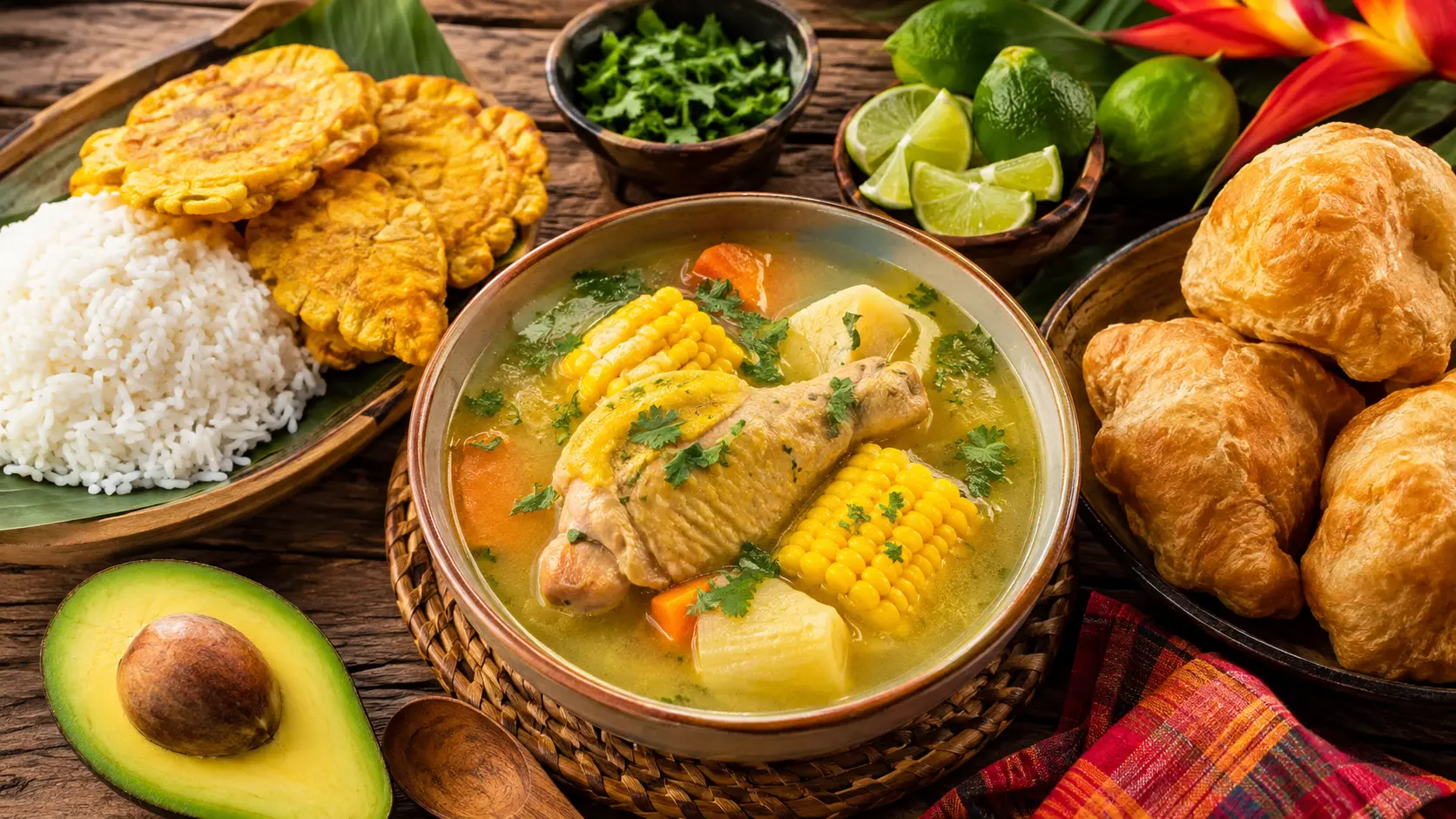
Start with sancocho de gallina. It is Panama’s national dish, and it is on almost every local menu. One bowl also tells you how Panamanians cook: slow, savory, built on root vegetables, and not remotely spicy.
After that, the order barely matters. What helps is knowing what you are looking at. A few Panamanian food words mean something different here than they do elsewhere, and that is where first-timers go wrong.
Panamanian food is not chili-hot. Heat lives in a small dish on the table, not in the pot. If you want it, ask for ají chombo the local hot pepper sauce. If you don’t, you will rarely meet it by accident.
Start with sancocho
Sancocho de gallina is a hen soup built on root vegetables and one dominant herb. Versions of sancocho exist across Latin America, but the Panamanian one has its own character and its own name: sancocho de gallina panameño.
The traditional version is short on ingredients. Panamanian cooks and chefs describe a core of hen, ñame, culantro, water and salt, with onion, garlic and oregano common additions. It is usually served with a bowl of white rice on the side, and many people spoon the rice straight into the soup.
Three things surprise first-timers:
- The hen, not chicken. Sancocho is made with an older bird — a gallina de patio, or yard hen. Its meat is firmer, so it holds together during a long simmer rather than falling apart.
- Culantro is not cilantro. They are different plants. Long serrated leaves, a much stronger flavor, and it is the taste people most associate with sancocho.
- Ñame is the anchor. A starchy tropical yam, thickening the broth as it softens. Yuca, otoe, and green plantain often join it.
The dish is associated with the Azuero Peninsula in the country’s southwest. Panamanians widely treat it as a restorative: a cure for a cold, a long night, or a hot afternoon.
Your first Panamanian breakfast
Breakfast is where visitors most often order the wrong thing, and it comes down to one word.
A Panamanian tortilla is not a Mexican tortilla. It is a thick, fried disc of ground corn. Think small savory cake, not wrap. Order one expecting something to fold, and you will be surprised.
The other staple is hojaldre (also written hojaldra), a piece of fried dough, light and a little chewy. Some people eat it plain, some dust it with sugar, and some use it to mop up whatever else is on the plate.
Around one or both of those, expect some combination of:
- Fried or scrambled eggs
- Queso blanco, a mild white cheese
- Salchicha, or stewed shredded beef (carne guisada, carne desmechada)
- Coffee, usually strong and often sweet
For example, stopping at a roadside fonda along the Interamericana or near Vía Argentina in Panama City typically gets you a fresh, piping-hot hojaldre, two fried eggs, a generous slab of salty queso blanco, and bistec picado (chopped braised beef) served on a sturdy paper plate with black coffee (café negro). The entire spread rarely costs more than $3.50 to $5.00.
Your first lunch: the fonda plate
Lunch is the main meal of the day, and the most useful word in this guide is fonda. A fonda is a small, inexpensive local eatery serving home-style plates that change daily. This is where most Panamanians eat lunch and where visitors find the most representative food, usually at a fraction of restaurant prices.
The standard plate is built the same way almost everywhere: rice, a protein, and something fried on the side.
| Component | What you’ll usually see |
|---|---|
| Rice | White rice, or arroz con guandú — rice with pigeon peas, often cooked with coconut milk |
| Protein | Ropa vieja (slow-cooked shredded beef in a red sauce), stewed chicken, fried fish, or stewed pork |
| Side | Patacones — green plantain sliced, smashed flat and fried twice — or yuca frita |
| Extra | A small salad, a spoonful of beans, or a fried plantain in its sweet ripe form |
Ask for the comida corriente or the plate of the day, and you get whatever the kitchen cooked that morning. That is usually the right order.
Fried snacks worth ordering
Panamanians have a deep affection for fried corn and fried yuca, and these appear at breakfast, as snacks, and alongside main meals.
- Carimañola — a torpedo-shaped fritter of mashed yuca stuffed with seasoned ground meat, then deep-fried.
- Empanada de maíz — a corn-dough turnover filled with chicken or beef. Sturdier and less flaky than a wheat-pastry empanada.
- Bollo — corn dough cooked in the husk. The bollo preñao version is stuffed with stewed pork or chicken.
- Patacones — the default side dish and the one most visitors end up ordering repeatedly.
- Chicharrón — fried pork, sold in pieces at markets and roadside stands.
Seafood and ceviche
Panama has coastline on two oceans, and seafood is both good and cheap.
Ceviche here is usually made with corvin, a firm white fish cured in lime with onion, culantro,ro and sometimes ají. It is served cold, often in a small cup, and eaten as a snack as much as a starter.
In Panama City, the seafood market is the standard place to try it, along with fried whole fish and patacones. Markets and their opening hours change, so check before making a trip across town.
Guacho is worth knowing too: a thick, soupy rice dish, often with seafood, closer to a stew than to a rice plate.
Why Panamanian food tastes the way it does
Panama’s tourism authority describes the country as a transit zone since the Spanish arrival. It links the Americas and connects the world, and that traffic has always brought ingredients and cooking customs with it. The history shows up directly on the plate.
Four layers are easy to taste:
- Indigenous. The peoples of the isthmus, including the Guna, Ngäbe and Emberá, cultivated maize, yuca and other roots long before anyone else arrived. Corn and root vegetables still anchor the cuisine.
- Spanish. Colonization brought hens, pork, rice, onion, garlic and oregano, and stewing as a method. Sancocho and ropa vieja both sit in this lineage.
- African and Afro-Antillean. Enslaved Africans arrived during the colonial period. Later waves of West Indian workers came for the trans-isthmian railroad in the 1850s, and then for the canal. They brought coconut milk, curry, ginger, and hot peppers. Panama’s official tourism site notes that 33.2% of the population identified as Afro-descendant in the 2023 census. That population is concentrated in Panama, Colón and Bocas del Toro provinces.
- Chinese. Large enough that it gets its own section below.
American influence arrived later through the canal era and shows up mainly in fast food and supermarket staples rather than in traditional cooking.
The Chinese layer you’ll notice immediately
This is the part most food guides mention in passing, and visitors notice within a day.
Chinese laborers were brought to Panama to build an interoceanic railway between 1850 and 1855. An early group arrived in 1854 aboard a clipper ship, contracted to the railroad company. Many stayed.
Canal construction later drew workers from the West Indies, Europe and elsewhere. By then, the Chinese immigrants who had remained were already providing services to them, food included.
The result is a food culture where Chinese dishes are not foreign cuisine; they are ordinary. Practical consequences for a visitor:
- Arroz frito shows up everywhere. Fried rice is a normal side dish next to fried fish or grilled chicken, including at fondas in small towns.
- Dim sum is a weekend institution. Locally,y it is sometimes called Chinese breakfast. Restaurants fill up on Sunday mornings with families of every background. Visiting with children? See our guide to kid-friendly days out in Panama City.
- Many fondas run hybrid menus. Roast pork, stir-fried noodles and fried rice sit on the same board as ropa vieja and patacones, all cooked with local seasoning.
If a Panamanian invites you to breakfast on a Sunday, do not be surprised if it turns out to be dumplings.
How food changes across the country
National dishes are national, but regional cooking differs enough to be worth planning around.
The Caribbean coast — Colón and Bocas del Toro. The most distinct food in the country. Coconut milk is central. Look for rondón (also written run down), a stew of fish or seafood simmered in coconut milk with root vegetables until it thickens. Alongside it you’ll find coconut rice, patí (a spiced beef turnover), johnny cakes and bon bread. Saus, a dish of pickled pig’s feet, turns up at local festivals. This is also the one region where food is more likely to carry real heat.
Azuero and the interior. The countryside heartland, and the region most associated with sancocho itself. Tamal de olla — a tamal cooked as a casserole rather than wrapped — is a regional specialty, as are corn bollos.
Chiriquí and the highlands. Coffee country. The Boquete area grows Geisha coffee, which has an international reputation among specialty buyers. Almojábanos, fried corn-dough sticks, are a regional favorite.
Guna Yala and the islands. Fish, lobster and octopus straight off the boat, usually with coconut rice.
Sweets and drinks
Panamanian desserts lean on milk, corn, coconut and sugarcane rather than chocolate.
- Bienmesabe — a soft milk-and-rice sweet, widely loved and made differently depending on where you are.
- Cocada — a coconut sweet, sold in small pieces.
- Huevitos de leche — milk and sugar cooked down, rolled into balls and dusted with sugar.
- Sopa borracha — sponge cake soaked in syrup and liquor, served at weddings and celebrations.
- Raspao — shaved ice with fruit syrup and condensed milk, sold from carts.
Bienmesabe panameño is distinctly associated with the Chiriquí province (particularly around Dolega and David). Unlike Spanish almond versions or Venezuelan coconut cakes, the traditional Chiricano recipe is prepared by slowly reducing cow’s milk, raspadura (unrefined raw cane sugar), and finely ground rice flour in large pots for hours until it forms a thick, rich caramel paste, traditionally served in bijao leaf wraps or small cups.
For drinks:
- Chicha — fresh fruit drinks, made to order. Tamarindo, maracuyá, nance and saril are common.
- Chicheme — ground corn with milk and spices such as cinnamon or nutmeg. Cold in most of the country, sometimes served warm.
- Agua de pipa — green coconut water, drunk straight from the coconut.
- Seco Herrerano — a spirit distilled from sugarcane and widely treated as Panama’s national drink. Mixed with milk, it becomes seco con leche. For where to drink in the evening, see our ranked shortlist of Panama City rooftop bars.
Our Panamanian coffee guide covers Boquete, Geisha and how to order coffee locally.
Where to find the real thing
Three habits get visitors to local food quickly.
- Look for the word fonda. Plastic chairs, a board with the day’s plates, a queue at noon. That is the sign you found the right place.
- Eat at markets. Public markets have food counters, and they cook for the people working there rather than for visitors.
- Order the plate of the day. It changes with whatever was bought that morning, and it beats ordering à la carte on both price and freshness.
Restaurant names, opening hours and prices change constantly, so treat any specific recommendation — including ours — as something to check before you travel. Our best restaurants in Panama City guide is updated separately, and the cost of living in Panama guide covers what eating out actually costs.
In Panama City, the Mercado de Mariscos (Seafood Market) at the start of the Cinta Costera is the undisputed hub for fresh ceviche de corvina (typically $2.50 to $4.00 per cup served with salty crackers and cold national beer). For classic fonda cooking in the capital, counters like Fonda El Cocotudo or neighborhood stalls in Calidonia and El Cangrejo serve daily comida corriente featuring ropa vieja, arroz con guandú, and fresh patacones for under $6.00.
Frequently asked questions
What is the national dish of Panama?
Sancocho de gallina, a hen soup with ñame and culantro, served with white rice on the side.
Is Panamanian food spicy?
Generally no. Dishes are seasoned rather than hot, and ají chombo is offered separately at the table. The Caribbean coast is the exception, where Afro-Antillean cooking uses more heat.
What do Panamanians eat every day?
Rice with a stewed protein and something fried alongside. It appears at almost every meal, and the fonda plate is the everyday format.
What is Panama famous for, food-wise?
Sancocho, patacones, ceviche, fried corn and yuca snacks, and Geisha coffee from the Boquete highlands. Panama is also known regionally for the quality and everyday presence of its Chinese food.
What should a first-time visitor order?
Sancocho on day one. A fonda plate with ropa vieja and patacones for lunch. Breakfast of tortilla or hojaldre. Ceviche in the afternoon. Dim sum if your visit includes a Sunday.
Is it safe to eat street food in Panama?
Use the same judgment you would anywhere. Busy stalls with high turnover, food cooked to order in front of you, and a counter that looks clean. Our street food guide covers this in more detail.
Where to go next
Order sancocho on your first day, then use the fonda plate as your default for the rest of the trip. Between those two, you will have eaten more representative Panamanian food than most visitors manage in a week.
Thinking about staying? Our guides to grocery shopping in Panama and the cost of living in Panama are the practical next reads. The Panama travel guide covers the rest of the trip.
Last verified: 18 August 2026

Abakwa Studio is the publishing team behind Lifestyle Panama, with a background in advertising technology. Our guides are drafted with AI assistance and then reviewed by our editor, Muhammad Shoaib, who has experience working as a visa agent in Pakistan. For visa, residency and tax topics, we check our guides against official Panamanian government sources. They are general information, not legal or tax advice.

