


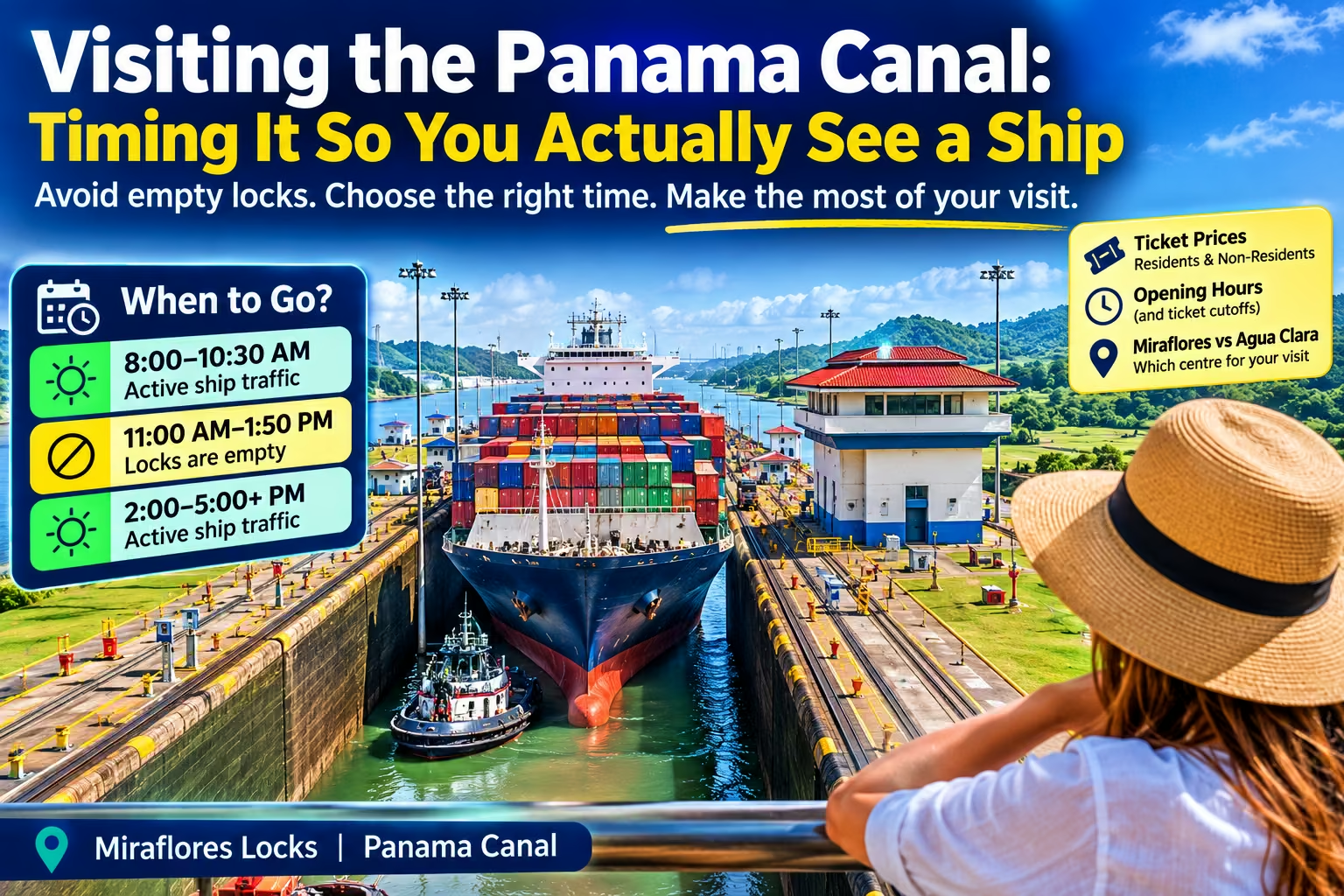
Visiting the Panama Canal: What to Expect
The single most common disappointment at Miraflores is arriving at a sensible hour, around lunchtime, and looking down at still, empty water for two hours.
That is not a slow day, and the attraction is not overhyped. It is the canal working exactly as designed. Ships move through in one direction for a block of hours, then traffic stops entirely while the waterway is cleared, then it resumes the other way. Land inside that changeover and there is nothing to wait for, because no ship is permitted to be there.
Every guide publishes a timetable, and no two agree, because the changeover moves with daily traffic. This page gives you the mechanism instead, so you can work out any date, plus what the visit actually delivers and what you’ll pay at both price tiers.
Three terms first. A transit is one ship’s passage through the canal, and its direction is northbound from the Pacific toward the Atlantic, or southbound the other way. The Culebra Cut is the narrow channel carved through the continental divide, the tightest section of the route. Neopanamax ships are the larger vessels that only fit through the expanded locks, not the original ones.
Key takeaways
- Midday is the dead window. Traffic runs in directional blocks with a changeover between them, commonly several hours.
- No fixed timetable is reliable. The changeover shifts daily, which is why four sources give four different “best times.”
- Residents pay $3.00, non-residents $17.22 at Miraflores. Residents under 18 enter free, and seniors pay $1.50. Bring the cédula.
- The ticket office closes well before the centre does. Buying online sidesteps that entirely, and the Canal now sells tickets on its own site.
- The official visit length is about 90 minutes, and the film runs 45 of them. Plan for that or skip one.
- Miraflores is the original locks. Agua Clara shows the expanded locks and the big ships. They are different experiences, not two branches of the same one.
- Published opening hours contradict each other, including one source that contradicts itself. Confirm against the Canal’s own site, not against an article.
Why the locks empty out at lunchtime
The canal handles roughly 36 to 40 transits a day across its three lock complexes. Divide that across the complexes, and you get something like 12 to 14 each, which averages out to a ship roughly every 90 minutes.
That average will mislead you badly, because the ships do not arrive evenly spaced.
The constraint is the Culebra Cut. It is the narrowest stretch of the whole route, and for large vessels it has historically handled traffic in one direction at a time. A ship cannot simply wait for a gap, because the gap is the entire waterway being used by traffic going the other way.
So the canal batches. A block of northbound ships moves through, the Cut is cleared, and then a block of southbound ships comes the other way. Between those blocks there is a changeover, and it can run for several hours.
The practical consequence at the visitor centre: for a stretch in the middle of the day there is nothing coming, and no amount of patience produces a ship. Case in point, the most common complaint about Miraflores is not the price or the crowds. It is standing over empty concrete at 12:30 in the afternoon.
The Panama Canal Daily Transit Flow (Miraflores)
Why the locks empty out mid-day: Directional batching through the single-lane Culebra Cut.
Why the published timetables disagree
You will find morning windows given as 8:00 to 9:00, as 9:00 to 11:00, and afternoon windows given as opening at 1:50, at 2:00, at 3:00. None of these sources is being careless. They are snapshots of different days.
The changeover time is a function of the day’s traffic: how many ships are queued, how large they are, what the maintenance schedule looks like. It moves. A fixed timetable published in an article is a photograph of one day being presented as a rule, which is why following one and finding empty locks feels like being lied to.
Treat any specific time you read, including the ranges above, as a rough prior rather than a plan.
Checking your own date
Since the mechanism moves, the only reliable approach is to check for the day you are actually going.
Check the Canal’s own visitor site the morning of your visit. It publishes transit information, and it is the source the timetables in every article are ultimately derived from, at second or third hand and several months late.
Ask the visitor centre directly if the day matters. For a one-shot visit built into a cruise stop or a departure day, a phone call the morning of is worth more than any guide.
Aim for the edges rather than the middle. Without any information at all, early morning and mid-to-late afternoon are better bets than midday, because the changeover sits between the blocks rather than at the ends of the day.
A note on guided tours. Tour operators often say they time arrivals around expected transits, and that may well be true. It is also a selling point published by a party with an interest in the sale. If timing is your priority, the same information is available to you free, and the tour’s real advantages are transport and commentary rather than privileged scheduling.
The official visitor site (visitcanaldepanama.com) does not reliably publish a live, minute-by-minute ship tracker for tourists. The best heuristic remains the structural one: morning traffic generally runs until roughly 10:25 AM, and afternoon traffic resumes around 1:50 PM. The window between 11:00 AM and 2:00 PM is the dead zone. For same-day confirmation, you can reach the Miraflores center at +507 276-8431.
Miraflores or Agua Clara
These are genuinely different visits, and choosing on convenience alone is how people end up at the wrong one.
| Miraflores | Agua Clara | |
|---|---|---|
| Side | Pacific, near Panama City | Atlantic, near Colón |
| Locks | The original locks | The expanded locks |
| Ships | Standard sizes | Neopanamax, visibly larger |
| Non-resident adult | $17.22 | $10.00 |
| Child 6 to 12 | $7.22 | $5.00 |
| Adult with disability | $8.61 | $5.00 |
| Resident adult | $3.00 | Confirm at the counter |
| From Panama City | About 20 minutes | A long half day |
| Facilities | Larger centre, museum, film, restaurant | Smaller, viewing focused, Gatún Lake views |
Choosing Your Visitor Centre: Pacific vs. Atlantic
Two distinct lock systems with different ship sizes, facilities, and hard ticket cutoffs.
- Location: Pacific Side (20 mins from City)
- Vessel Type: Classic Panamax ships
- Lock Technology: Original 1914 historic locks
- Facilities: 4-story museum + 45-min IMAX film
- Ticket Cutoff: Windows close at 5:00 PM
- Location: Atlantic Side (Colón, 1.5 hrs)
- Vessel Type: Massive Neopanamax mega-ships
- Lock Technology: 2016 Expanded water-saving basins
- Facilities: Open viewing deck + Gatún Lake panoramic view
- Ticket Cutoff: Windows close early at 3:30 PM
Choose Miraflores if you are based in Panama City, you have half a day rather than a full one, you want the museum and the film, or it is your only canal visit,t and you want the classic view from directly above the chambers.
Choose Agua Clara if you want to see the big modern ships, you are on the Atlantic side already, particularly on a cruise stop at Colón, or you have been to Miraflores and want the other half of the story.
Do not treat them as interchangeable. “Seen one lock, seen them all” is the assumption that sends someone across the isthmus for a second visit that looks like the first, or keeps them at Miraflores when the Neopanamax vessels were what they actually wanted to see.
What ninety minutes actually buys you
The Canal’s own material puts a Miraflores visit at approximately an hour and a half. It is worth being honest about how that time divides, because expectation mismatch is the top complaint.
The film runs 45 minutes. Screenings are listed roughly hourly through the day, and the ticket includes it. So the film alone accounts for half of the official visit duration. If a ship arrives while you are inside, you miss it. If you queue for a busy screening, you may not get in at all, which is a documented complaint from visitors who paid full price and never reached the theatre.
The decks hold 450 people. That is a real capacity limit, and it explains what happens on a Saturday afternoon in season. The centre received close to 800,000 visitors in a recent fiscal year.
The viewing itself is slow. A lockage takes time. Water moves, gates open, a ship inches forward. People who arrive expecting spectacle sometimes describe it as slow-motion water, and that description is fair. What makes it compelling is scale and proximity: at Miraflores the ships are lifted or lowered 16.5 metres across two chambers, and you watch from under 50 metres away.
The honest downside, stated plainly: on a crowded day, at a changeover, with the film queue full, a non-resident pays over $17 to stand shoulder to shoulder looking at still water. That is a real outcome, and reviewers report it. Everything else on this page exists to help you avoid it.
The honest upside: timed properly, at a quiet hour, watching a ship that weighs tens of thousands of tonnes be lifted by nothing but gravity and water is not something the photographs prepare you for.
The bad Saturday
The failures above rarely arrive one at a time, and when they stack, they all produce the same sentence afterwards: it wasn’t worth it.
A Saturday afternoon in season looks like this. The changeover is running, so the chambers are empty. Deck capacity is at or near its 450-person limit, so the good positions are gone. The film queue is long enough that joining it means missing anything that does arrive, and short of that you simply do not get in. And a resident who left the cédula at home paid the full non-resident rate on top.
Four separate things, four separate fixes, and the visitor leaves with one impression. This matters for how you read reviews of the place: a poor review usually describes a badly timed visit rather than a bad attraction, and it rarely says which of the four went wrong.
Which is the useful conclusion. Fixing one of them is not enough on a busy day. Going midweek addresses crowding and the queue at once. Going at the edges of the day addresses the changeover. Carrying the card addresses the price. Those are three habits, not three tickets.
Hours, cutoffs and what you’ll pay
The hours problem
Published opening hours for both centres contradict each other, and I could not resolve them. The spread across current sources includes Miraflores closing at 5:00 pm and at 6:00 pm, with the ticket office variously at 3:30 pm and 5:00 pm. One page gives both versions within itself. Agua Clara is given as closing at 4:00, at 4:30 and at 5:00, with last entry variously at 3:15 pm and 3:30 pm.
What is consistent across every source is the structural point, and it is the one that gets people turned away: the ticket office shuts well before the centre does. Arriving at 4:45 for a centre that closes at 5:00 does not get you in, and the gap can be as much as ninety minutes.
Two things protect you. Buy online. The Canal sells tickets through its own visitor site, which removes the ticket-office cutoff from the equation entirely. And confirm the day’s hours on that same official site, not from an article, including this one.
The hours are resolved. According to the Canal Authority, Miraflores is open daily from 8:00 AM to 6:00 PM, but the ticket office strictly closes at 5:00 PM. Agua Clara is open from 8:00 AM to 5:00 PM, and its ticket office closes even earlier, at 3:30 PM. If you arrive at Agua Clara at 3:45 PM, you will be locked out, even though the center is technically open for another hour and fifteen minutes. Buying online via visitcanaldepanama.com is the only way to bypass these hard window closures.
Both price tiers
Non-resident admission, from the Canal Authority’s published rates:
| Miraflores | Agua Clara | |
|---|---|---|
| Adult | $17.22 | $10.00 |
| Child 6 to 12 | $7.22 | $5.00 |
| Under 6 | Free | Free |
| Adult with disability | $8.61 | $5.00 |
| Child with disability | $3.61 | $3.61 |
Panamanian nationals and legal residents pay a different tariff entirely. At Miraflor’s, that is $3.00 for an adult, $1.50 for a senior, and free for residents under 18, on presentation of valid ID.
That is not a discount you ask for. It is a separate rate, and you claim it by producing your cédula at the window. A resident who does not present one pays roughly five times what the person beside them paid, for the same view.
If you have residency, carry the card. If you are still working out which residency route fits, our Pensionado Visa guide covers the one most retirees use.
Getting there
To Miraflor, es it is about twenty minutes from central Panama City. Taxi and ride-hailing both work, and the trip is short. If you have a full day instead, compare other day trips from Panama City, and families can pair the locks with these kid-friendly things to do in Panama City. Tours bundle it with Casco Viejo or the Causeway, which is a reasonable way to fill a day if you would rather not arrange transport. If you stay in Casco Viejo after dark, our ranked rooftop bar shortlist covers which terraces let non-guests in.
To Agua Clara, it is a considerably longer journey to the Atlantic side, and most visitors reach it either as part of an organised trip or by car. Cruise passengers docking at Colón are already close. If you are driving yourself from Panama City, treat it as a full-day commitment rather than an afternoon, and plan the return leg before you set out rather than after.
Read next: our guide to day trips from Panama City, for building the rest of the day around it.
On the decks
Small practical points that decide whether a well-timed visit stays enjoyable.
The viewing decks are exposed. Little shade, tropical sun, and a lot of concrete. This is the most common reason people cut short a visit they timed correctly: hat, water, sunscreen.
Timing versus heat pull in opposite directions. The best viewing windows are early morning and mid-to-late afternoon, and midday is both the dead window and the hottest part of the day. That is a convenient alignment: there is little reason to be there at noon.
Accessibility. The lower platform at Miraflores has wheelchair access. If mobility matters, ask at the entrance which levels are reachable rather than assuming all four are.
Allow more than the official 90 minutes if you want both a transit and the film. The stated duration assumes things go smoothly.
Before you go
- Pick your centre on what you want to see, not on what is closest.
- Check the Canal’s official site for the day’s hours and transit information, on the morning itself.
- Buy online so the ticket-office cutoff cannot catch you.
- Aim for the edges of the day, not the middle.
- Bring your cédula if you have one, and sun protection regardless.
Panama Canal Visit Pre-Flight Checklist
Verify your departure details before setting out to avoid ticket lines and empty lock chambers.
Editorial Review & Verification
- Written by: Abakwa Studio Editorial Team
- Operational & Pricing Review: Canal transit batching mechanics, ticketing cutoffs, and 2026 resident vs. non-resident tariff structures.
- Last verified: September 1, 2026
- Review status: Ticketing policies, visitor center hours, and admission tiers verified against current Autoridad del Canal de Panamá (ACP) operational guidelines. Transit batching schedules are structurally verified but remain subject to daily maritime traffic variations.
Primary Sources
- Autoridad del Canal de Panamá (ACP) — visitcanaldepanama.com
- Miraflores and Agua Clara Visitor Center Operational Guidelines (2026)

Abakwa Studio is the publishing team behind Lifestyle Panama, with a background in advertising technology. Our guides are drafted with AI assistance and then reviewed by our editor, Muhammad Shoaib, who has experience working as a visa agent in Pakistan. For visa, residency and tax topics, we check our guides against official Panamanian government sources. They are general information, not legal or tax advice.

